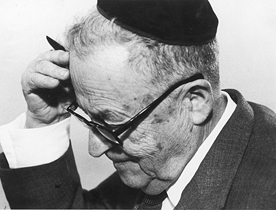
In honor of Jerusalem Day, following is one of my favorite quotations of S.Y. Agnon, who was awarded the Nobel Prize for Literature in 1966, from the collection of his short stories “Within the Walls”, (the Hebrew follows the English translation; I take responsibility for the latter):
There are places in Jerusalem that are familiar to me, and that I know well. But when I chance upon one of them, it seems to me that I’ve never seen it before.
In contrast, there are places that I’ve never been to before in my life, but when I chance upon them it seems to be that they are familiar to me, and I know them well.
And since all the days – including the nights – I would wander through the [streets and] squares of Jerusalem, I didn’t make the time to learn any trade. Even worse, I didn’t make time to study Torah. And a Jew who doesn’t occupy himself with Torah – his heart berates him and says, “And what will you answer on Judgment Day when they ask you if you occupied yourself with Torah?” What would I answer? I would answer: “I occupied myself with Jerusalem,” and I’m confident they will say, “You did well!…”
מקומות יש בירושלים שאני מכיר אותם ויודע אותם וכשאני מזדמן לאחד מהם דומה עלי שלא ראיתיו מעולם.
כנגדם יש מקומות שמימי לא הייתי שם וכשאני בא לשם דומה עלי שאני מכיר אותם ויודעם.
ומחמת שכל הימים לרבות הלילות מרבה הייתי לשוטט בחוצות ירושלים לא פניתי ללמוד שום אומנות. קשה מזה הייתי בטל מן התורה ויהודי שאינו עוסק בתורה ליבו מוכיחו ואומר, ומה אתה משיב ביום הדין כשישאלו אותך עסקת בתורה. ומה הייתי משיב. הריני משיב עסקתי בירושלים, ומובטחני שיאמרו לי יפה עשית…
Starting Sunday evening, May 9 through Monday, May 10 we observe “Yom Yerushalayim” – Jerusalem Day, marking the day on the Hebrew calendar when the Old City of Jerusalem (and especially the Kotel – the Western Wall), was liberated during the Six-day War and became part of one united Jerusalem under Israeli control. For many in Israel – and throughout the Jewish world – this is both a national and religious holiday. (Not everyone sees it that way.)
For me, the holiday is particularly significant, as I was blessed to visit Israel and Jerusalem for the first time, on the Ramah Seminar, during the summer of 1967 – just a few weeks following the Six-Day War. Thirteen years later my family and I moved to Jerusalem. For nearly 40 years our home has been in the southern neighborhood of Gilo, founded just four years after the war in what became Greater Jerusalem.
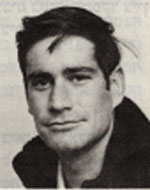
Yosef Sarig, 1944-1973
There have been many songs written about Jerusalem – before and since the Six-Day War. I would like to share one of my favorites with you – less known internationally than the famous “Jerusalem of Gold.” The song, “OHR VIRUSHALAYIM” – “Light and Jerusalem,” was written by Yosef Sarig (pronounced: sah-REEG). On this post you’ll find a link to one of several renditions of the song, as well as a link to the lyrics in Hebrew and English. The story of how it came about is as moving as the song itself:
The following is based on recollections by Yosef’s mother and brother, Tikva and Tzachki. His father was General Nahum Sarig, commander of the legendary Palmach unit in the Negev Desert during the 1948 War of Independence.
The Sarig family lived on kibbutz Bet Hashita in the Bet She’an valley in the north of Israel. In January of 1963, Yosef’s grandmother died. Since she was a fourth – or fifth – generation Jerusalemite, the parents borrowed one of the kibbutz trucks to bring the deceased to eternal rest in Jerusalem. The parents sat in the cabin of the truck and their five children sat in the back – together with the coffin. It was a particularly wintry day and it poured most of the way. All of a sudden, as they approached the beginning of the steep ascent to Jerusalem (at Sha’ar Hagai), the sun started to come out and a rainbow appeared. The rays of the sun piercing through the clouds, which accompanied them all the way to the cemetery, particularly made an impression on Yosef.
In January, 1972, Yosef, who was a talented musician and song-writer, was asked to write a song about Jerusalem for the Gevatron (singing) Ensemble’s performance in honor of Jerusalem Day that year. One evening he went to his room and in matter of hours wrote both the music and lyrics for the song. He came out and – as was his custom – he showed the lyrics to his mother asking if it was any good. She saw right away that his words described the light that they had seen on their way to Jerusalem exactly nine years earlier. She looked at him and said, “It’s enchanting… but what about the music?” He pulled out another page with the music which seemed to resonate perfectly with the lyrics.
On October 10, 1973, just a year and five months after the song was first performed, Major Yosef Sarig fell in battle on the Golan Heights. He was buried in his kibbutz along with ten other sons of the kibbutz who died in the Yom Kippur War. (The kibbutz was the community in Israel with the highest per capita casualties of that war.) Yosef’s brother, Tzachki, had been wounded at the beginning of the war and was in the hospital when Yosef was killed. His family waited until Tzachki was on his way to recovery before telling him the sad news. He became depressed with guilt, saying: “Why him and not me!”
OHR VIRUSHALAYIM became an instant “hit” and ever since has become an integral part of Israel’s musical legacy. It’s been translated into several languages. A folk dance to the song was choreographed by Shoshana Koplewitz. Ironically the lyrics do not mention the name of the city, except in its title. There’s no need; the song describes Jerusalem in a most unique and beautiful way. In 1975 Yosef was posthumously awarded the Medal of Distinguished Service (Itur Hamofet), but his songs – especially Ohr Virushalayim – were his awards to the nation. May his memory continue to be for a blessing.
Some links:
The song as sung by the Gevatron Ensemble:
https://youtu.be/94M7zG-Hcy4
The lyrics in Hebrew and English: See PDF above to view or download.
The State of Israel is celebrating its 73th year of independence this week (April 14 eve-15 in 2021), which is always preceded by a very sombre Memorial Day – Yom Hazikaron. This year we memorialized the 23,928 soldiers that fell in defending the State. The dramatic events leading up to the Declaration of the State of Israel on Friday, the 5th of Iyyar 5708 (corresponding then to May 14, 1948), are too many to discuss here. But here are 10 quick facts that you may not have known from other sources – unless you already visited Israel’s Independence Hall, currently undergoing major renovations. This is just a selection of my favorite tidbits:
1. The Provisional Council (the pre-state quasi-government) only voted to declare independence on May 12 – just two days before the declaration. David Ben Gurion, the head of the Council, said, “It’s now – or never!” The vote was 6 in favor and 4 against (there were three other members of the Council who could not attend: two were under siege in Jerusalem and one was abroad). That was a close call!
2. Although the British were only set to depart on Saturday, May 15, the Provisional Council knew that it would be impossible to hold a ceremony declaring independence on Shabbat (the Sabbath), so they set the time for Friday at 4:00pm, just a few hours before Shabbat was to start, and 8 hours before the official end of the British Mandate. People were asked to come at 3:30 and the ceremony started precisely at 4:00 (yes, it actually started on time!).
3. It would have been most appropriate to announce independence in Jerusalem, the historic capital of the Jewish people; however, city was under siege by local Arab militia. Consequently, it was decided to hold the ceremony at what had been the art museum of Tel Aviv since 1936. Prior to that it had been the private home of Meir Dizengoff – the first home built in the new “neighborhood” of Tel Aviv. In 1911 Dizengoff became the first mayor of Tel Aviv. Outside the Hall of Independence is a sculpture of Dizengoff riding his female horse, so there is Mayor Meir on his mare!
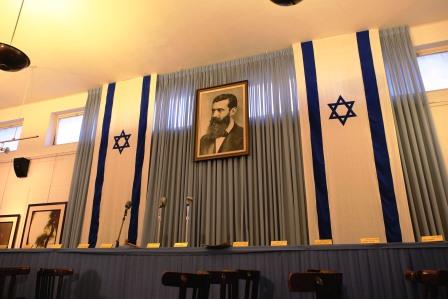
Independence Hall Dias Today
4. The art museum was chosen because the main hall had high windows and the room could have served as a makeshift bomb shelter, in case the Arab countries would attack that day. The museum didn’t have enough chairs for the some 250 people who were invited to attend the ceremony. So, on Friday they had to run around to local cafes asking to borrow chairs!
(Pri-Or_Photohouse)
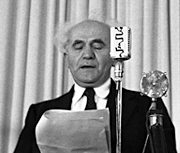
5. They knew they would need amplification for the ceremony, so they turned to a store called “Tzlil” (literally: sound or tone) and asked to borrow a microphone and amplifier. The owner generously said that he would donate the equipment – on the condition that the name of his store appear on the microphone. Thus “Tzlil” became the first advertisement in the new State of Israel! (Left: see the writing on the microphone next to David Ben Gurion)
Outside the Hall of Independence
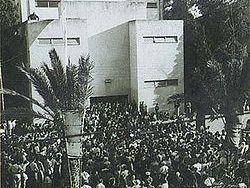
6. Invitations had to be hastily hand-delivered to some 200+ people. The invitation said that it was classified and that the invitees should keep the contents of the invitation secret! (See the photo – right – of the throngs of people waiting outside during the Declaration!).
7. The text of the Declaration of Independence wasn’t finalized until an hour or so before the ceremony. Ben Gurion was busy making corrections practically on his way to the ceremony! A fancy parchment had been prepared – but it was blank! Ben Gurion read the Declaration from the type-written, correction-riddled pages, hidden by the parchment! Those that were asked to come up and sign the Declaration following the ceremony did so on blank parchment!
(Israel Philatelic Federation)
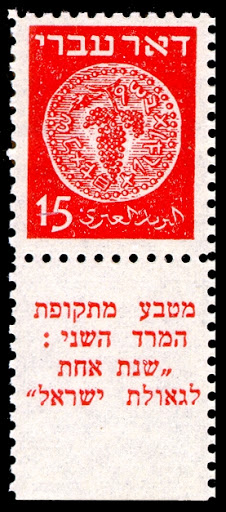
8. The name of the new state was not announced prior to that Friday, which is why there was such a rousing applause during the declaration ceremony when David Ben Gurion (who became prime minister) announced that the new country would be called: “The State of Israel.” Among other names that had been suggested were: Judea, Zion and even Eretz Yisrael (the Land of Israel). But all of the trappings of a new state had to be put into motion even before the declaration. Not knowing what the country would be called they had issued postage stamps that read: דואר עברי “Do’ar Ivri” or “Hebrew Post”! (See picture, left)
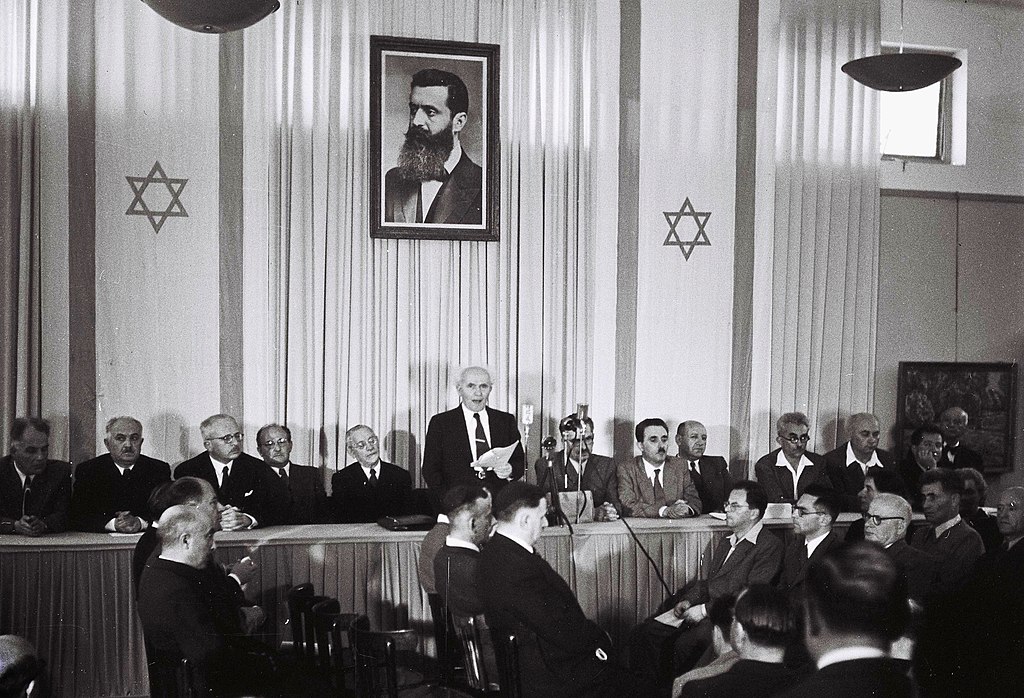
9. There were only two women who signed the Declaration parchment: Rachel Cohen-Kagan (who became a member of the first Knesset/Parliament) and Golda Meyerson, who later Hebraized her surname to Meir – destined to serve as prime minister of the State, 1969-1974. (In the picture below, one can see a partial profile of her, sitting in front of the third man from the right at the dais). Golda Meir cried through much of the ceremony. When asked if she had been crying because she was overwhelmed with excitement, she is purported to have responded that she was crying for the 6 million Jews for whom the State of Israel was declared a few years too late.
TEL AVIV, ISRAEL – MAY 14: In this handout from the GPO, David Ben Gurion, who was to become Israel’s first Prime Minister, reads the Declaration of Independence May 14, 1948 at the museum in Tel Aviv, during the ceremony founding the State of Israel. (Photo by Zoltan Kluger/GPO via Getty Images) *** Local Caption *** David Ben Gurion
10. In the crowded room there wasn’t enough space for the orchestra, which had to be placed one floor above the hall. When Ben Gurion called the meeting to order, someone had to run upstairs to tell the orchestra to start playing Hatikva -“the Hope,” which was later adopted as the national anthem of the new State of Israel.
Sorry, you could look on Waze or Google Maps, but you won’t find a street in Jerusalem (or elsewhere in Israel) named for Wilfrid Israel: a remarkable Jew, and proud German, who saved many more Jews than Oskar Schindler – before and during the Holocaust.
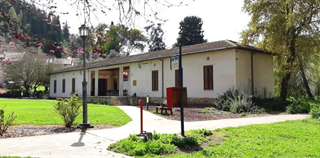
Wilfrid Israel Museum, 2021
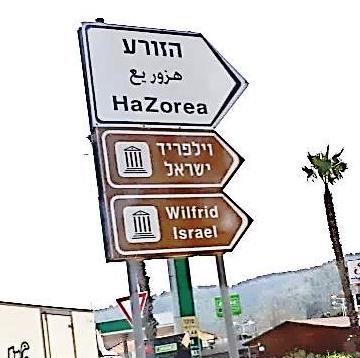
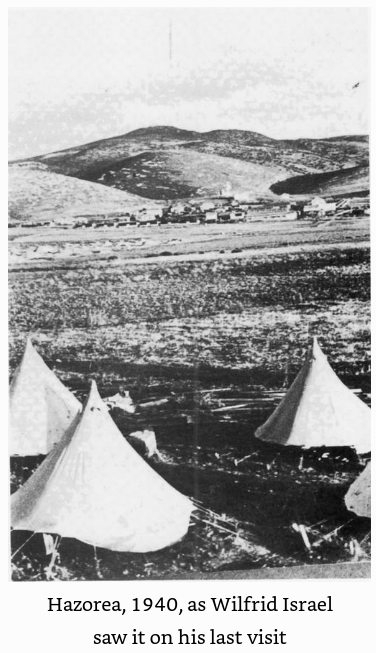
However, in the heart of Kibbutz Hazorea (pronounced: ha-zo-RAY-ah), in the western Jezreel valley of Israel, there is a boutique art museum named for Wilfrid Israel. Friends of his from Berlin were among the founders of the kibbutz in 1934, and Wilfrid visited the fledgling kibbutz twice (in 1934 and 1940), but he was not a member. How did he come to merit having a museum in his name established on this particular kibbutz?
To discover the answers to the questions above, you are encouraged to read the biography, see the movie, and/or or, at least, read about him on Wikipedia (See “Sources and References” below). These were the main sources of information for this post. In the meantime…
In honor of Israel‘sHolocaust Martyrs’ and Heroes’ Remembrance Day(Yom HaShoa VehaGevura), which will be observed on April 7/8, 2021, I present below a thumbnail overview of the unassuming and indefatigable Wilfrid Israel.
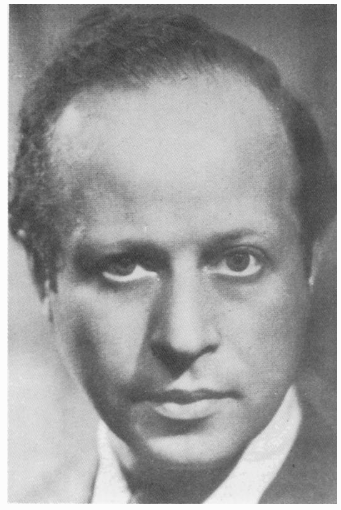
Wilfrid Israel, 1942
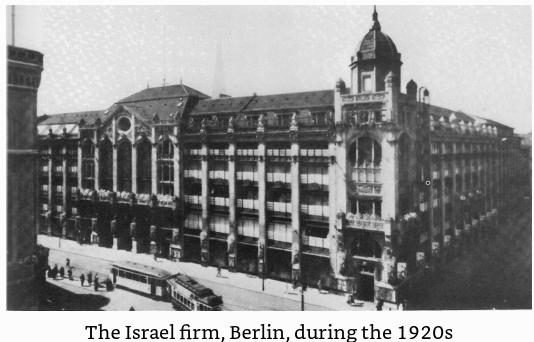
Wilfrid Berthold Jacob Israel (hereafter: Wilfrid) was born in London on July 11, 1899 to a wealthy Jewish family, but grew up and lived in Berlin. His great-grandfather, Nathan, founded the department store “N. ISRAEL” in Berlin, which remained in business until February, 1939. Wilfrid dreamt about becoming a sculptor, but with family pressure he eventually assumed the directorship of “N. Israel,” until the department store was taken over by the Nazis.
(Bertha Heilbut, New York)
Wilfrid’s mother’s grandfather, Nathan Marcus Adler, was Chief Rabbi of the United Hebrew Congregations of Great Britain. The family Wilfrid was born into was not religiously observant; however, much like other prosperous German Jews in the early 20th century, they were very involved in the Jewish community.
Wilfrid was active in the Werkleute (literally, “work people”) – a German Jewish youth movement, in which he and his friends studied Jewish history and customs, but were not outwardly religious. Some of his friends from the Werkleute made Aliya (moved to Israel) in 1933, and in 1934 established Kibbutz Hazorea. Meanwhile, Wilfrid was attracted to Martin Buber’s intellectual approach to Judaism and utopian Zionist vision of a bi-national state.
Following are some highlights of Wilfrid’s many accomplishments (not in chronological order):
* Served as a key link – together with the Quakers from the UK – in organizing the “Kindertransport” operation that brought over 10,000 German Jewish children to England in the late 1930s.
* Aided Recha Freier in the founding of “Youth Aliya” (the effort to bring children to pre-state Israel before and during World War II).
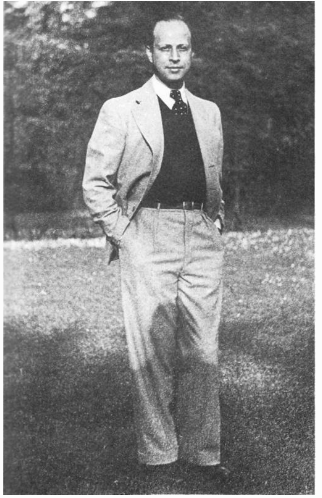
Wilfrid at Schwanenwerder, Berlin, about 1932 (Yosef Amir)
* Was appointed the international chairman of the Ben Shemen youth village in Palestine.
* Saved hundreds of Jewish – as well as non-Jewish – employees of “N. Israel” department store from the clutches of the Nazis.
* Ransomed hundreds of Jews from the Gestapo.
* Convinced the British authorities to establish a transit camp in Britain for young men released from the concentration camps in Germany, and consequently saved thousands of lives.
* Met often with Zionist leaders; such as: Chaim Weizmann, Max Warburg and Henrietta Szold.
* Was a frequent guest at the home of Albert Einstein, who said about Wilfrid: “Never in my life have I come in contact with a being so noble, so strong and selfless as he was – in very truth a living work of art” (From a condolence letter to Wilfrid’s mother, Amy Israel, soon after Wilfrid was killed; from the archives of the Wilfrid Israel Museum).
* Studied in the adult Jewish education settings established by Martin Buber, who described Wilfrid as “a man of great moral stature [who] was dedicated to the service of others.” (From N. Shepherd, see below)
* Escaped to London in 1939 and became an advisor to British MPs and ministers regarding the fate of European Jews influencing policy makers behind the scenes.
(Kibbutz Hazorea Archvices)
* Seriously considered making Aliya (moving to pre-state Israel) when the war would come to an end. In fact, at his request, the members of Kibbutz Hazorea agreed (after a heated debate) that Wilfrid would be allowed to build a bungalow on their property where he could fulfill his dream of being a sculptor.
* Traveled to Portugal and Spain to help Jewish children make their way to Palestine.
All the above – and much more – Wilfrid managed to achieve until his tragic death just a month shy of his 44th birthday. On June 1, 1943, he was flying from Lisbon to London when the commercial airplane he was on was shot down by the German Luftwaffe (Nazi air force).
In his will (which, ironically, he had written just before he flew to Portugal) Wilfrid had bequeathed his extensive art collection of mostly sculptures from the Far East to Kibbutz Hazorea. The kibbutz members began building the Wilfrid Israel Museum in 1947, and opened the museum in 1951.
In August, 2020, there was a major burglary at the museum and, unfortunately, many of Wilfrid’s Far Eastern sculptures were stolen; to date, none have been recovered. Nonetheless, the museum still functions and exhibits works of contemporary Israeli artists.
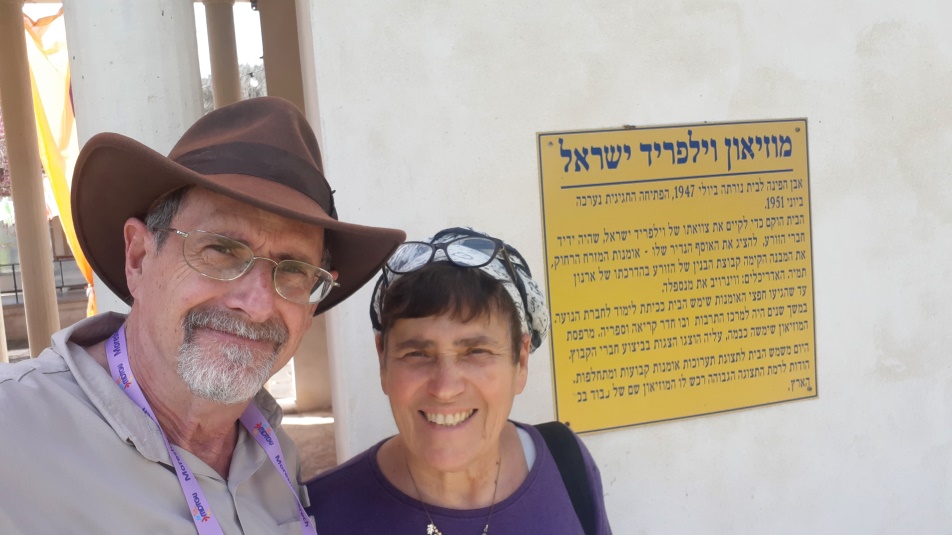
Joe and Sue Freedman at the Wilfrid Israel Museum, March, 2021
My wife, Sue, and I recently made a “pilgrimage” to the museum, which is a beautiful tribute to a humble but amazing personality.
So, how is it that we don’t hear more about Wilfrid Israel (and yours truly only found out about him a couple of months ago)? Why is there no street named for him? How is it that even Kibbutz Hazorea members don’t publicize Wilfrid’s heroic life? There are a number of possible answers to these questions, which I would be happy to discuss in a virtual lecture/tour. Contact me for more information. In the meantime, I encourage you to do some research (see the following):
Sources and References
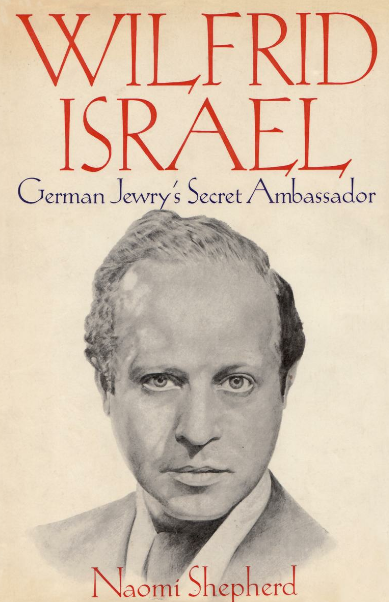
>The comprehensive and fascinating book, “Wilfrid Israel: German Jewry’s Secret Ambassador,” by Naomi Shepherd, re-published in the UK by Halban Publishers Ltd as an ebook only. See: https://www.halbanpublishers.com/nonfiction#/wilfrid-israel/ A print edition, under the name: A Refuge from Darkness: Wilfrid Israel and the Rescue of the Jews, is available from Amazon. I am grateful to the publisher and author for permission to display photos from the book in this post.
>The Israeli filmmaker, Yonatan Nir, made an outstanding documentary movie, “The Essential Link: The Story of Wilfrid Israel,” in 2017. For a trailer in English, see: https://www.wilfridisraelfilm.org/ The film will be screened on the eve of Holocaust Memorial Day, April 7, 2021 at 8pm, Israel time. (The registration form is in Hebrew: https://www.yonatannir.com/wilfridisrael)
(a composite from the Hebrew press, February 18, 2021)
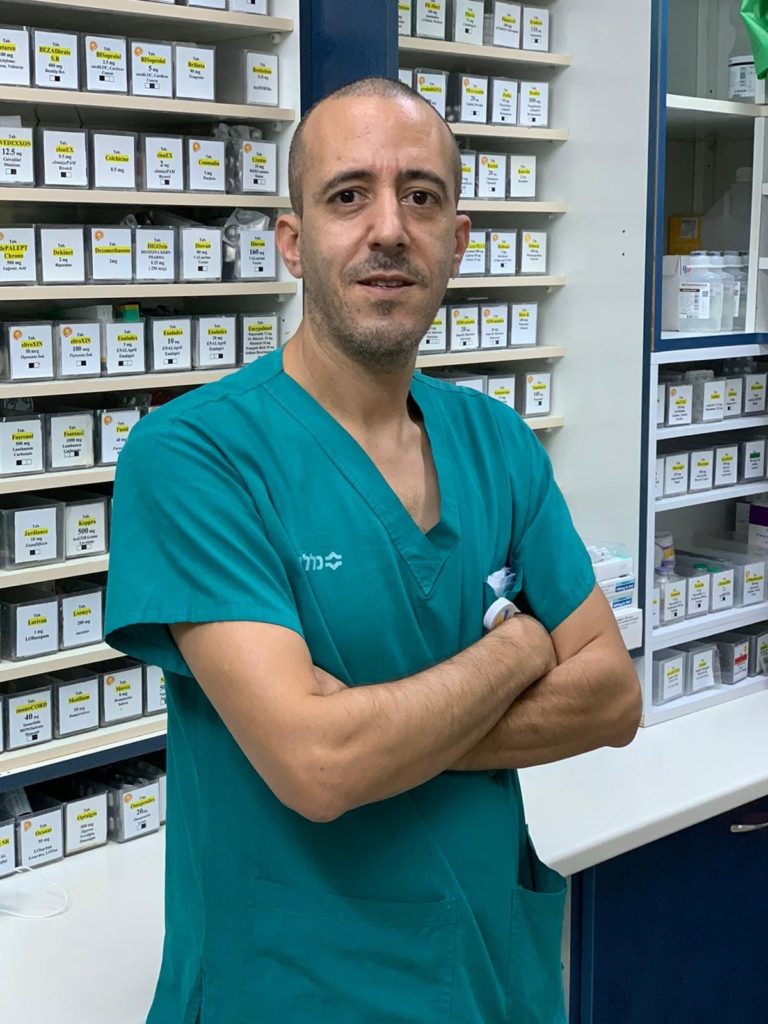
Maher Ibrahim (see picture below) is a Muslim who lives in the bedouin village of Daburiyya at the foot of Mt. Tabor. He works as the head nurse in the Covid-19 ward in Ha’Emek Hospital in Afula in the north of Israel. Recently he found himself in a most unusual situation that led to him to take a Siddur (Jewish prayer book) and read the “Sh’ma Yisrael…:” (“Hear, O Israel, the Lord our God, the Lord is One,” Deuteronomy 6:4) for a patient – a Chabad chassid, Shlomo Galster, 74 years old.
In the words of Nurse Ibrahim:”There was a religious, Jewish patient whose condition was deteriorating quickly towards death. We contacted the family and they set out on a journey from the area of Netanya to Afula, and were delayed by weather and traffic. All their way we prayed that the family would make it in time – at least to see their father in his final moments. Unfortunately, his death was imminent and would occur before the family would arrive.”
He related on a radio program this morning that his professional experience had taught him that many people, regardless of religious affiliation, ascribe tremendous importance to the final prayer before death:
“I studied for an MA in gerontology at Ben Gurion University (Beer Sheba), and I took a couple of courses in Judaism. One learns how to connect Judaism to the world, to life and death. I’m not familiar with all the (Jewish) prayers, but I know that it is customary to say “Sh’ma Yisrael” before the end of life, so I stood at the head of the bed and said, “Sh’ma Yisrael”. By the time his daughter arrived, it was too late – he had already expired. I could see that she was looking for closure, so I told her what I had done.”
He added: “I told the daughter that I didn’t know if what I did was acceptable or not because I’m Muslim and he’s Jewish. But I said it (the Sh’ma) and if he heard me, then the prayer was the last words he heard…” According to Maher, towards the end of Shiva the daughter called him and said that his actions were the only thing that gave her comfort, and that she looked forward to the end of Corona to give him a hug.
Maher: “The reaction of the daughter warmed my heart. Sometimes we’re the last voice that a patient hears, especially during COVID-19 with the closed wards and inability to arrange meetings with the families. We (the staff) need to be human beings for the patients before we are there for them as medical professionals. This is what needs to be done and we will continue to do.”
Maher Ibrahim (Photo from Facebook of Yoseph Haddad)
Joe Freedman, Ed.D. (In honor of International Holocaust Memorial Day, January 27)
“A good name is better than fragrant oil” (Ecclesiastes 7:1)
Did you know that Jerusalem has a street named: רחוב צביה ויצחק “Rehov Tziviya ve-Yitzhak” (Zivia and Yitzhak street)? Jerusalem – as well as most cities in Israel – is super meticulous about naming streets. There are two very prestigious committees which makes decisions about the City’s street names, one headed by a former Supreme Court judge!
One can learn a lot by just walking down the streets of Jerusalem and paying attention to their names. Sometimes a street-sign gives a few word explanation of its name. Many street names memorialize personalities from Jewish and Zionist history (from Ruth to King David to King Agrippa to Theodor Herzl…). Some neighborhoods have street names with a common theme or period of history (the 12 Tribes, medieval Jewish scholars and poets…). In my neighborhood of Gilo (first established in 1971), walking through the streets you’ll mostly “meet” streets named for flowers, precious stones and spices (I live on Ha-Rosmarin – Rosemary – st.).
Among the few streets named for people in our neighborhood is “Zivia and Yitzhak Street.” Since moving to Gilo in 1982, I’ve always found that name to be strange. It’s rare that one street is named for two people (and using just first names at that), but I never bothered to do any research about it.
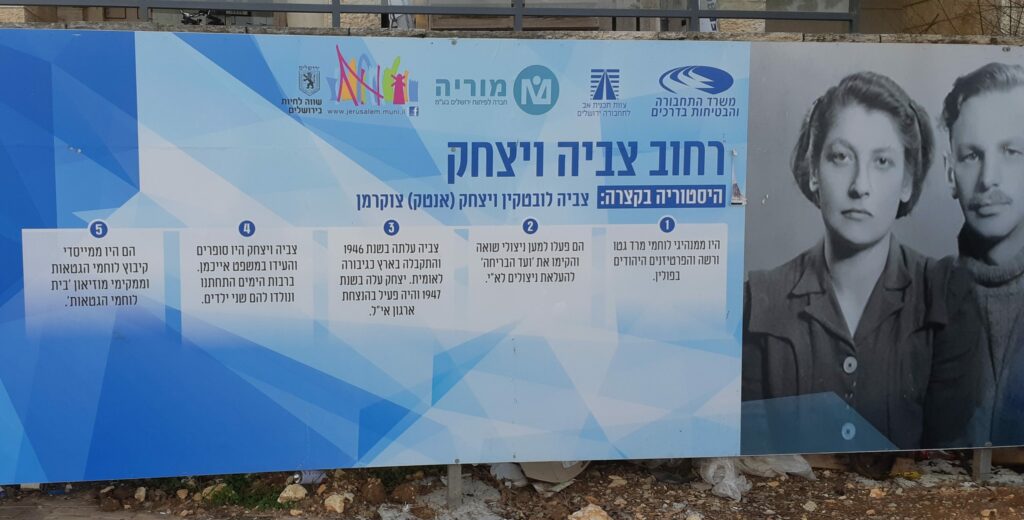
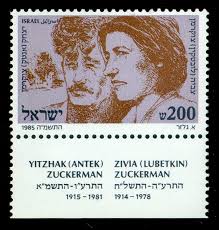
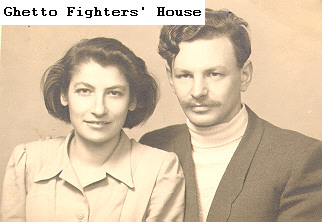
That changed just a few weeks ago: as I took a brisk walk down that street (which is actually the continuation of my own), I ran across a large mural, put up along where the new light railroad line is being built (see picture below). I did a double-take as I noticed that the mural showed a picture of: ZIVIA and YITZHAK: Zivia (Lubetkin) Zuckerman (1914-1978) and Yitzhak Zuckerman (1915-1981)! It turns out that they were true heroes of the Jewish People. In fact, the mural capsulizes the story of the couple in five short points. Following is a free translation (and explanation) of those points:
1. Zivia (nee Lubetkin) and Yitzhak (wartime codename: “Antek”) Zuckerman were among the leaders of the Jewish Partisans in Poland as well as of the Warsaw Ghetto Uprising (April-May, 1943 – they were two of the mere 34 survivors of that Uprising).
2. After World War II they looked after fellow Holocaust survivors and took part in establishing the “Bericha” (escape) network to smuggle survivors out of Europe and into Eretz Yisrael (the Land of Israel).
3. Zivia made Aliya (moved to Eretz Yisrael) in 1946, and was received as a national heroine. Yitzhak made Aliya in 1947 and was active in the memorializing of leaders of the ZOB (the Jewish Combat Organization in Poland during World War II).
4. Zivia and Yitzhak were writers. They testified at the trial of Adolf Eichmann (1961). They got married and had two children: Shimon and Yael.
5. They were among the founders of the Ghetto Fighters Kibbutz (Kibbutz Lohamei HaGheta’ot) as well as the Holocaust museum (Bet Lohamei HaGheta’ot) on the premises of the kibbutz.
Do you see what you can learn by just walking down the street?! For more details about these remarkable heroes, do some Googling! I just wanted to add to the five points that in 2001, their granddaughter, Roni Zuckerman, became the first female jet fighter pilot in the history of the Israeli Air Force.
May the memory of Zivia and Yitzhak be for a blessing. – יהי זכרם ברוך