Categories
Author: Joe Freedman
Categories
FROM 7th of ADAR to OCTOBER 7th
The Hebrew month of Adar II (which began a few days ago) traditionally ushers in a season of joy. During this this month we celebrate the holiday of Purim and a month later Passover and other spring holidays. Whatever our situation might be in life, we are reminded not to worry….but to be happy (with apologies to Bobby McFerrin).
A curious exception to the mood of the season is the 7th day of Adar II (coinciding with Sunday, March 17, 2024), which is the day on which we mark the anniversary of the death of Moses, Our Teacher, Moshe Rabbeinu. However, as it says at the end of the book of Deuteronomy (34:6), “…no one knows his burial place to this day.” One of the outcomes of this situation was that Moses’s grave did not become a place of pilgrimage or worship.
Soon after the creation of the State of Israel, the Rabbinate of the IDF chose the 7th of Adar as the memorial day for fallen soldiers whose places of burial (and often the exact dates of their deaths) are unknown. What a wonderful way of connecting an ancient tradition with modern circumstances!
The National Military Cemetery at Mt. Herzl in Jerusalem has a special section for these soldiers, with appropriate “headstones”….but, of course, without their graves. It’s aptly called “The Garden of the Missing in Action,” arranged by time periods.
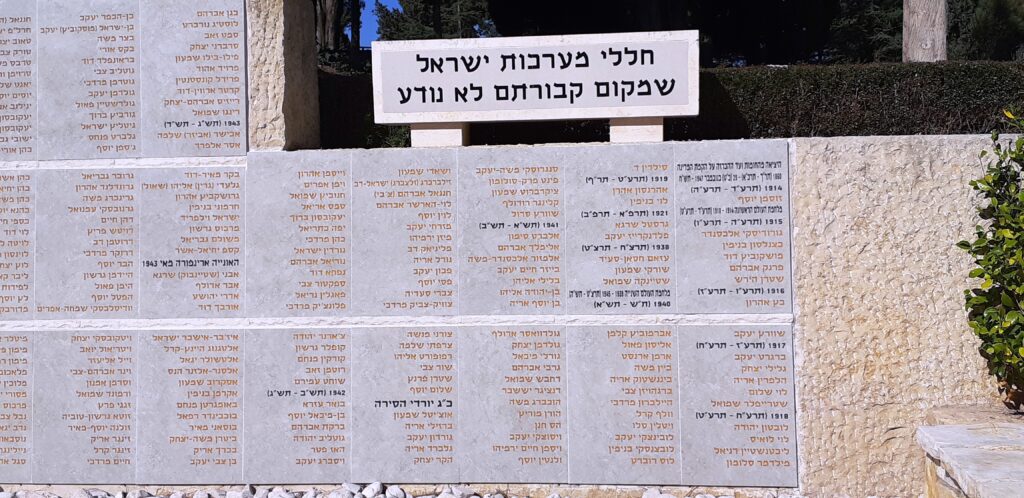
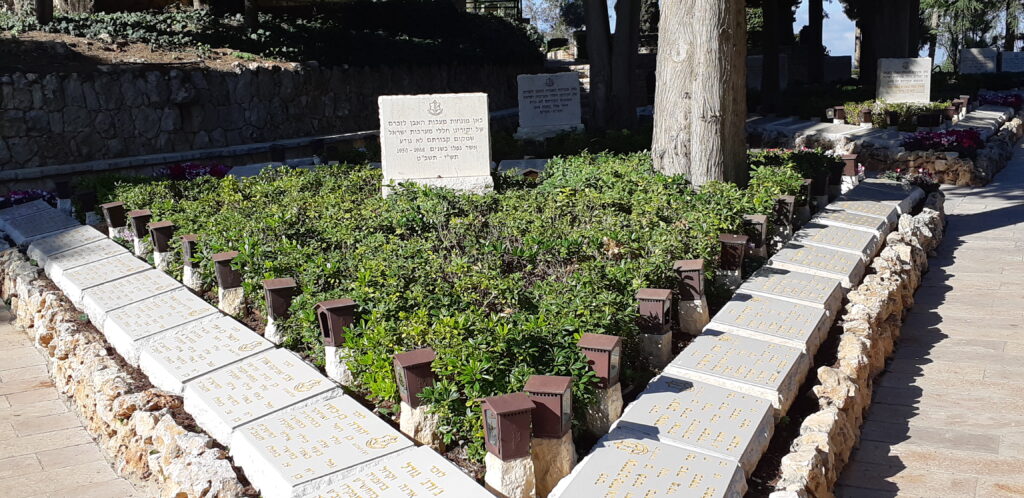
Among those memorialized in this section of the cemetery are Aaron Aaronsohn (a member of the pre-State NILI clandestine team that spied on Turkey for the British; he was killed in a plane crash in 1919)
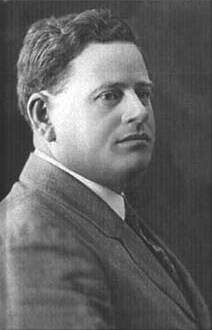
(1876-1919)
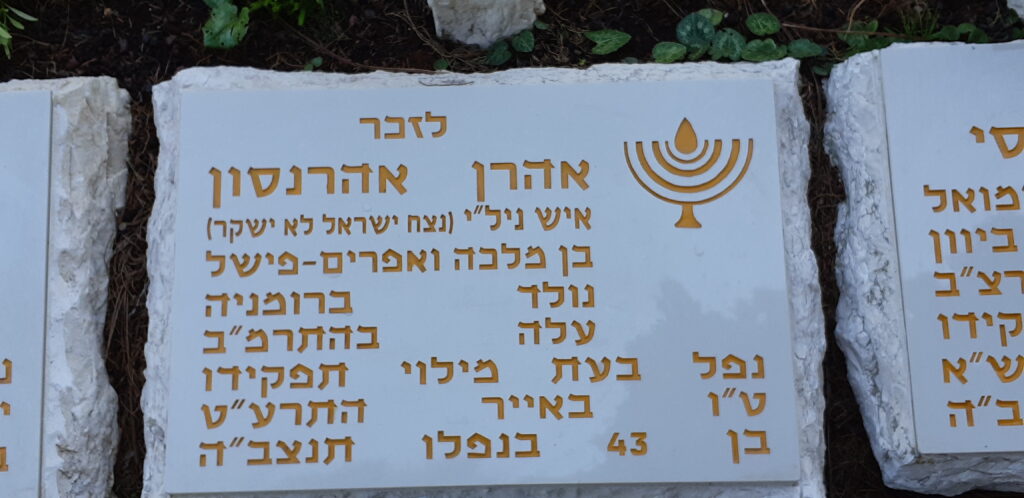
and the famous Israeli spy Eli Cohen (who was hanged in Damascus in 1965).
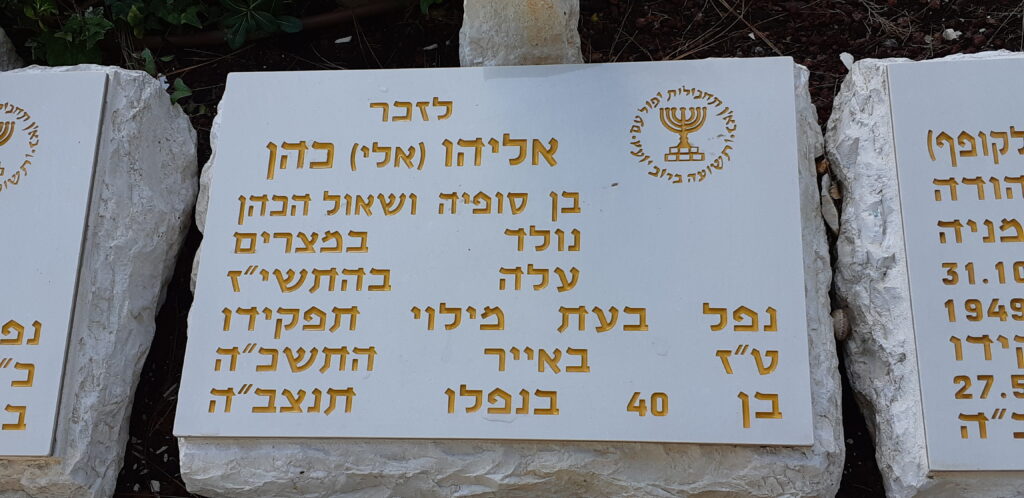
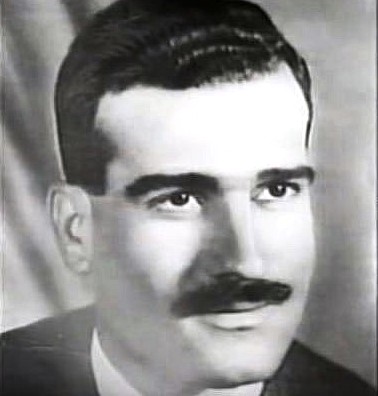
The cemetery also lists a number of soldiers whose place of burial became known during the years.
In the last 5+ months there have been scores of fallen soldiers – not to mention citizens – who were killed on October 7, and in its aftermath, whose remains have not recovered, even though they have been confirmed dead. While some may never be found, it’s certain that many bodies are being held by Hamas in Gaza. Our hearts go out to the families who have to live without adequate closure, knowing that their loved ones have been killed, but having no gravesite to visit or to care for.
We pray that all of the hostages will be returned to Israeli immediately, and that the remains of all those soldiers and citizens who were murdered be buried honorably in the Land of Israel.
Categories
Showdown on Mount Carmel
One of the outstanding features of this coming Shabbat’s Torah reading (known as Ki Tisa, Exodus 30:11-34:35), is the story of the Golden Calf. The Sages chose as the corresponding Haftarah – the reading from the Prophets – the story of the Prophet Elijah having a “face-off” with King Ahab and the prophets of the god Baal (I Kings 18:1-39). The connection? Both are highly dramatic stories of Israelites worshiping foreign gods and its consequences “of Biblical proportions!”
But it in most years a special haftarah, having to do with the season, is read instead of the Elijah story. This being a Jewish leap year (come to think of it, so is the secular year!) we get to read the very exciting story of Elijah which takes place at the highest point of the Carmel mountain range.
Today, on that location, known as Keren HaCarmel in Hebrew, there is a Carmelite monastery commemorating the Biblical event. In Arabic the site is known as Mukhraka: the place of the burning (figure out why!). From the roof of the monastery one is treated to one of the best panoramic views in the country, which includes the Jezreel Valley and a whole range of hills and mountains associated with Biblical stories. One can also see a bit of the Kishon stream – and even the Mediterranean Sea – which are mentioned in the Elijah story (no clues! you’ll have to read it on your own).
On one of the many tours that I’ve led, ascending to the Mukhraka rooftop, on a relatively clear day I managed to take a video, which I present here (about 1 minute). I added some place names for the reader’s convenience. The background music is from the song Shir HaEmek – the Song of the Jezreel Valley.
Enjoy!
Categories
The Return to Shokeda
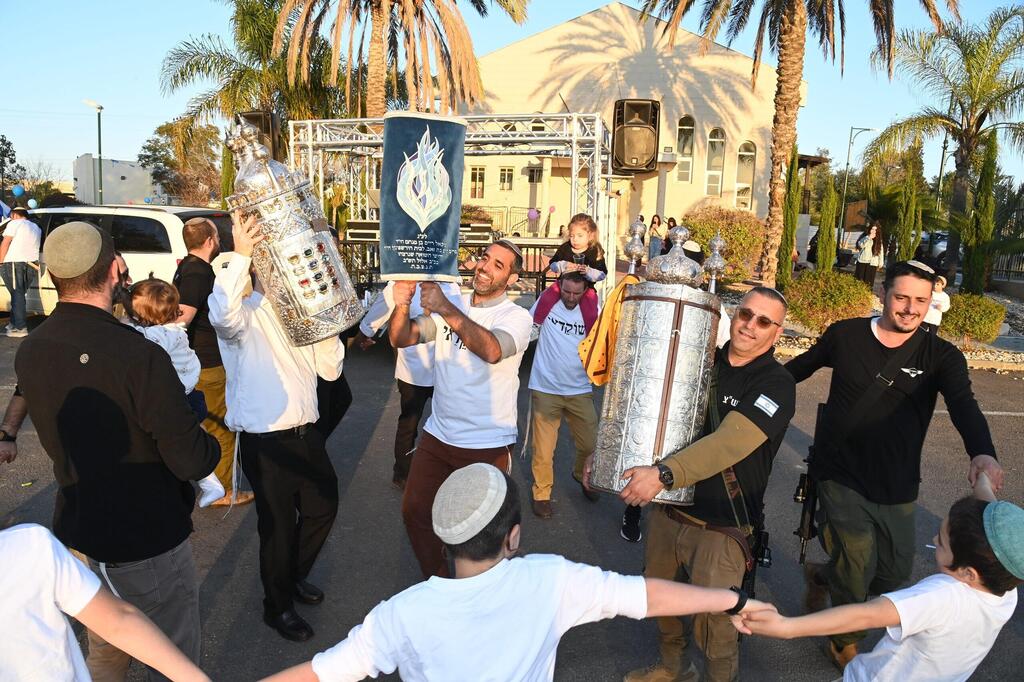
Photo: Herzl Yosef, as appeared in YNet
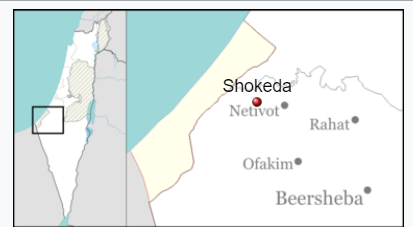
Moshav Shokeda, a religious agricultural community, is located very close to Be’eri and other kibbutzim near the Gaza border that were brutally attacked on October 7, 2023. But when the terrorists tried to cross the fields to Shokeda they were repelled by the IDF. While the moshav was spared for the most part, the community was evacuated due to their proximity to the destruction and the rocket attacks which continued sporadically during the following weeks. I visited the moshav in January and saw that it was largely deserted. On February 8, 2024, the residents celebrated their return to Shokeda.
From Sivan Rahav Meir, Yediot Aharonot, 22 February, 2024
(free translation from the Hebrew).
“Such are the instructions for the temple” (Ezekiel 43:12). זֹאת תּוֹרַת הַבָּיִת
These words appear in the Haftarah (selection from the prophets) from the prophet Ezekiel, read after the Torah portion. Specific details for building the Tabernacle are found in the Torah portion (Tetzaveh, Exodus 27:20-30:10)) and also in the Haftarah, such as how to build, what to take, what materials and measurements to use, and what are the building instructions. Our Sages explain that in our times we should also relate to our “tabernacle,” our private home which is a place for holiness, for the Divine Presence. Pay close attention to how it is built, especially in these days.
Hannah Cohen-Aloro returned after four and a half months at the Neve Ilan Hotel, to the moshav of Shokeda, near Be’eri. This is how she described her return to their “tabernacle” on Friday afternoon, the work of the tabernacle, and the lighting of the Eternal Light (see Exodus 27:20):
“I do a load of laundry, and another load, and another: sheets, towels, pillows, blankets. The teenagers and the Dyson vacuum cleaner are reshaping everything. Water spills, cleaning materials, music and the noise of life return. Quickly operating a mixer, rolling out dough, Karni running from corner to corner. ‘My doll.’ ‘My cart.’ ‘My kitchen.’ The children tidy up their beds, their yard, each their own corner. Aroma of cakes, vegetable peels, pot of meatballs, grilled meat, braiding challahs. Setting the table and I am in tears. The tablecloth, the utensils, the napkins, how everything is so emotionally moving. I lit [Shabbat] candles in the house, with olive oil, with our melodies. It’s simply a holy moment. And I slept like I haven’t slept since Simchat Torah (October 7th).
“That’s it, a week that we are at home. If I would write to you that I’ve felt all this week a revelation of Divine Presence it will sound strange and exaggerated, right? After Shabbat, on the first night I went out with the car, I drove on these dark roads here, and through all the kibbutzim on the way in darkness. Painful. This darkness is justified but dark. When I arrived home I parked the car and saw the lights of my house lit up. And I burst into tears. I just sat there and felt how it has fallen into our historical lot to be those who physically come and kindle the light. Let them see it on the road, in fields, in forests and in hearts. That our light is burning
Categories
“THUS DID THEY ENSLAVE YOUR CHILDREN”
A Midrash* about The Value of Life
(*homiletical interpretation)
On October 7, 2023, Hamas perpetrated a brutal, horrific massacre of Israel citizens, as well as of soldiers, killing at least 1350 people, and kidnapping at least 120 and smuggling them into Gaza. In addition, for the last 7 days Hamas has been firing rockets incessantly aimed at Israeli cities and communities.
In response Israel has been bombing Hamas targets in Gaza. Israel has already been criticized for killing or harming innocent Gazans. The UN, among other bodies, has come out strongly against Israel meting out collective punishment and preventing essential goods and services from entering Gaza. As in the past, they have demanded that, while Israel has the right to retaliate, it must be a “proportional response” (whatever that means).
Are Israel’s actions in this war defensible according to Jewish values and sources? While a thorough study would require a doctoral thesis, allow me to present one source which presents some of the dilemmas that I believe are applicable to the present situation.
War is hell, and the term “moral war” seems to be an oxymoron. But Israel, when forced to fight, strives to do so according to the principle of tohar haneshek -“purity of arms” (another ironic term). Among other aspects of this principle, Israel does whatever possible to avoid harming innocent bystanders. As I write the following appeared in The Times of Israel: “IDF warns civilians to leave northern Gaza as ground invasion looms.”
In Rabbinic literature we find discussions about whether one should rejoice at the downfall of evil people. On the one hand, it says in Proverbs (11:10):
..וּבַאֲבֹד רְשָׁעִים רִנָּה׃ “…When the wicked perish there are shouts of joy.”
On the other hand we learn in the same book: בִּנְפֹל (אויביך) [אוֹיִבְךָ] אַל־תִּשְׂמָח…
“If your enemy falls, do not exult; If he trips, let your heart not rejoice” (Proverbs, 24:17)
So which is it?! Do we cheer and sing victory songs when the wicked are defeated or do we desist from expressing joy?
At the Passover Seder, when we list the Ten Plagues, we spill out a drop of wine for each plague, symbolically lessening our joy out of sympathy for the Egyptian people who suffered and died as a result of the plagues (according to one explanation). But we also sing praises to God for drowning Pharaoh and the Egyptian soldiers in the Red Sea! This is a concrete example of the dilemma posed by the two verses from Proverbs above.
Following is a text from a late collection of midrashim – homiletical interpretations – known as Midrash Avchir (11th century). It’s a creative expansion of a passage from the Babylonian Talmud, Sanhedrin, 39b, which appears as the last paragraph of this text:
When the Holy One, Blessed be He, sought to drown the Egyptians in the sea, Uzza – the angel of Egypt – rose and prostrated himself before the Holy One, Blessed be He, and said before Him: “Master of the Universe! You created the world according to your attribute of mercy (midat haRahamim), why do You want to drown my children?!” The Holy One immediately convened the entire Heavenly Entourage and said to them: “You judge between Myself and Uzza, the angel of Egypt”. The angels of the nations of the world began speaking in Egypt’s defense. When (the angel) Michael saw this, he signaled to (the angel) Gabriel. The latter flew to Egypt in a single bound and removed one brick with its mortar, and found a baby in it which the Egyptians had imbedded in the building. He returned and stood before the Holy One, Blessed be He, saying, “Master of the Universe, THUS did they enslave Your children.” Immediately God judged Egypt by His attribute of justice (midat haDin) and drowned them in the sea.
At the same time, the ministering angels wished to sing before the Holy One, Blessed be He, but He said: “The work of my hands is drowning in the sea and you want to sing before me!?”
There are many lessons to be learned from this imaginative story and its application to the current situation. I’ll limit myself to a few points:
a. The Value of Life: God sees all people as his children; in this case: both Israelites and Egyptians. Life itself is an ultimate value that transcends national borders and identities. But when it became evident that the ancient Egyptians so disregarded human life that they embedded a baby in the mortar of their building (according to the midrash), God IMMEDIATELY drowned them in the sea.
b. Seeking Advice: We see that the angels challenged God (perhaps an echo of Abraham arguing on behalf of Sodom and Gomorra). Drowning the Egyptians would not be according to the merciful character of God, they argued. We see that God IMMEDIATELY convened the Heavenly Entourage, perhaps to teach a lesson to human judges and leaders that they should not make decisions autocratically.
c. A Game-Changer: The midrash implies that even God would not act without clear evidence that the Egyptians were deserving of being drowned. After all, for hundreds of years the Israelites were enslaved in Egypt. They suffered terribly without divine intervention. But Gabriel provided evidence that was overwhelmingly horrible: “THUS did they enslave Your children.” The midrash again used the word “IMMEDIATELY” to indicate God’s determination to carry out the intended punishment. The lesson is that there is justice in the universe, and there is a Judge.
d. Restraint: At the end of the midrash God admonishes the angels for wanting to sing praises to Him. After all, the Egyptians are His creations as well! Apparently since the Israelites were the ones who were saved, only they were entitled to sing praises (see the Song of the Sea, Exodus 15); however, the privilege was not accorded to the angels who were spectators. God was emphasizing that both these and those were His children.
————
Since 2005 when Israel completely evacuated Gaza, Hamas and Islamic Jihad – bent on the destruction of the Jewish State – have frequently bombarded Israel with rockets aimed at civilian populations. Most of the time individual or small spurts of rockets may have been ignored, or Israel may have made a point by bombing rocket launchers or known outposts of the terrorist organizations.
From time to time there have been battles, or wars (which Israel usually refers to as “Operations”), whereby Israel – provoked by constant rocket and mortar fire – has retaliated with air attacks and even infantry incursions into Gaza. Before bombing buildings or areas of suspected terrorists, the Israel Defense Forces (IDF) have either dropped leaflets or used random phone calls to tell the civilian population to evacuate the premises.
But on October 7: “THUS” did Hamas and the Islamic Jihad rape, torture, behead and otherwise murder men, women and children, in a most ruthless and barbaric manner. They also kidnapped dozens of civilians (in addition, perhaps, to soldiers in uniforms) and brought them to Gaza as hostages. Whole communities along the Gaza border have been burned and destroyed.
Hamas has proven that it has no regard for human life. Not only do they seek the death of Israelis – as well as Jews wherever they are – they have demonstrated that they do not care about the lives of their own citizens! When Israel recently told Gazans in the northern part of the Strip to evacuate and move southward (apparently in anticipation of a major incursion), Hamas responded: “We again call on [Gazan] citizens not to cooperate with the recorded phone messages that the occupation (i.e., Israel) is sending at random, asking people to leave their homes.” (Palestinian Media Watch, Bulletin, Oct 11, 2023). In the past, even the PA (Palestinian Authority, based on the West Bank) has criticized Hamas for their appalling policy of using innocent people as human shields, and issued this cartoon.

With all of its justification for wanting to cause the demise of Hamas, once and for all, Israel will still have to take precautions to avoid hurting Gazan citizens. Israel would not, God forbid, deliberately aim at civilian populations. At the same time, with Hamas’s tactics, it would be impossible to avoid some “collateral damage”.
Israelis have to keep their tzelem Elohim – their image of God – and not to gloat or cheer at the death of human beings, no matter how evil they may be (and how much more so over the death of innocent people who were caught in the crossfire). At the same time we must remain true to our resolve to wipe out the wicked and to protect the lives of Israelis at all costs.
Let us pray that the current war come to an end speedily, with Hamas in ruins and with Gazan citizens being harmed as little as possible. Let us hope that all of the hostages will be retuned unharmed, and that the surviving Israelis – whose homes are along the Gaza border – will soon be able to return and rebuild their lives, despite their heavy losses.
(The text of the midrash and some of the analyses are based on the publication “The Midrash and the Modern World”; the Melton Centre for Jewish Education in the Diaspora, Hebrew University of Jerusalem, 1982)
שירי רחל ונעמי שמר – לכבוד אריה (ראו להלן)
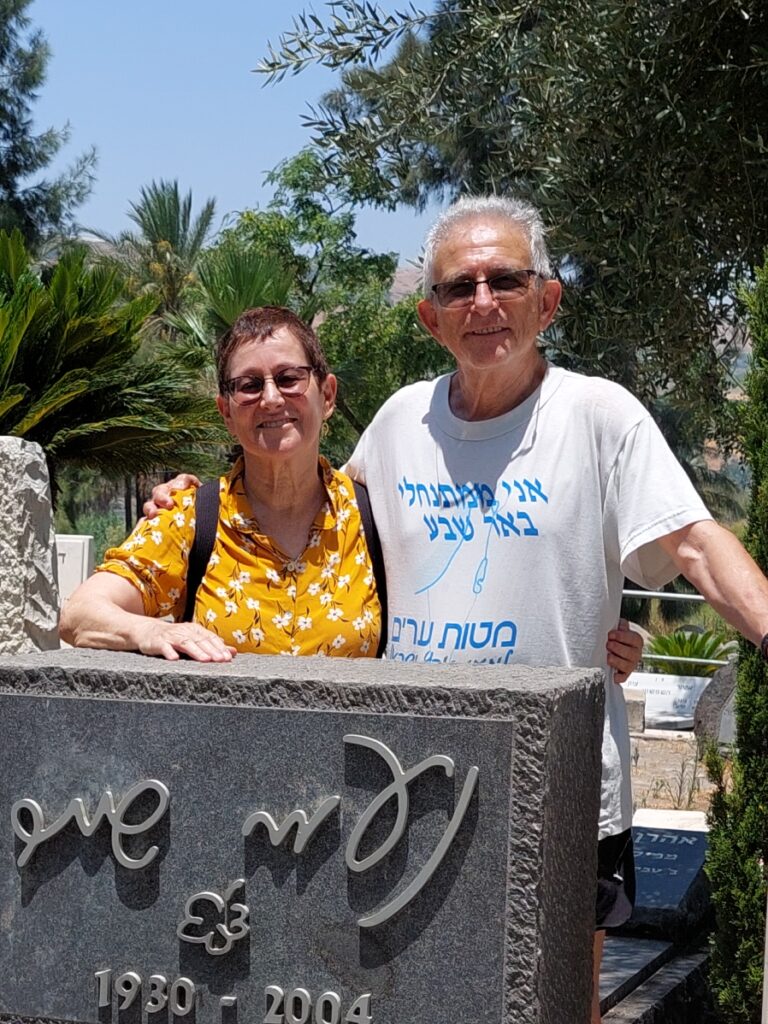
On a recent Friday (June 24, 2022) I had the honor and pleasure of guiding the extended Zartisky family, celebrating the 80th birthday of the scientist DR. ARYEH ZARITSKY (Ben Gurion University of the Negev).
The gift that Aryeh received was a family-oriented tour in the footsteps of two greats of Hebrew poetry and song: Rahel “the Poetess” (Bluwstein, 1890-1931) and Naomi Shemer (1930-2004).
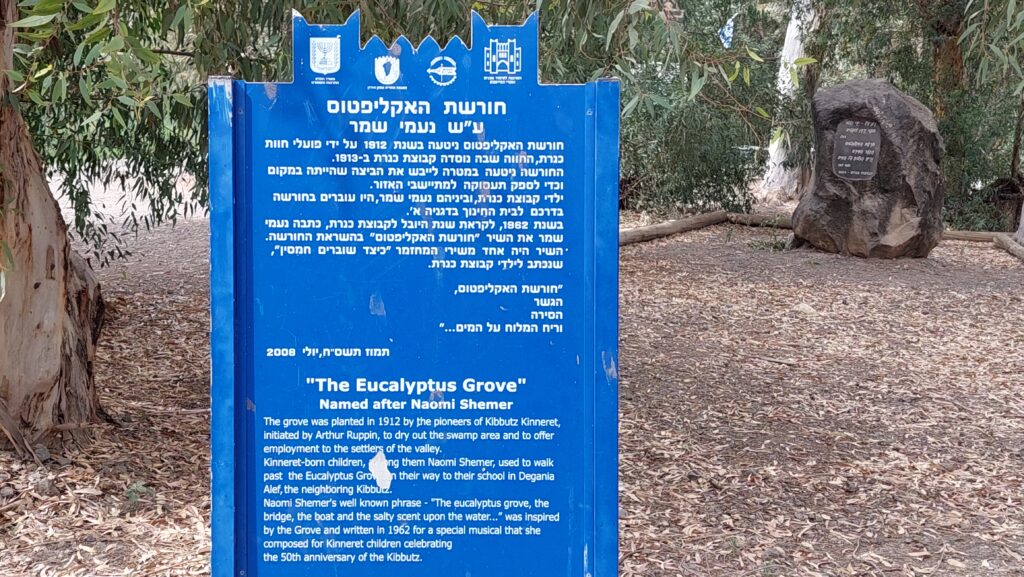
We visited the Kinneret Training Farm (where Rahel worked 1911-13) which is next to Moshava Kinneret , the Eucalyptus Grove that is located on the access road to Kvutzat (Kibbutz) Kinneret (where Naomi Shemer was born and raised), and the Kinneret Cemetery, where the two are buried so close to each other.
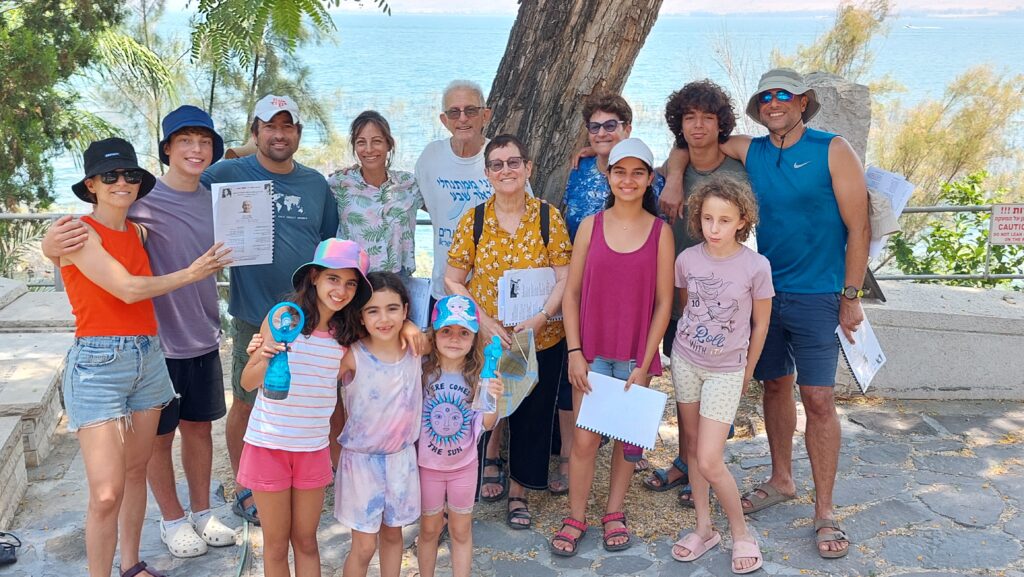
Like Rahel, we witnessed: “There are the Golan Heights…” and, in Naomi’s words, we “saw the Kinneret (Sea of Galilee) radiant with turquoise…” We spoke about the Second and Third Aliyot (waves of immigration: 1904-14 and 1919-23, respectively) and about the life-histories of the two artists.
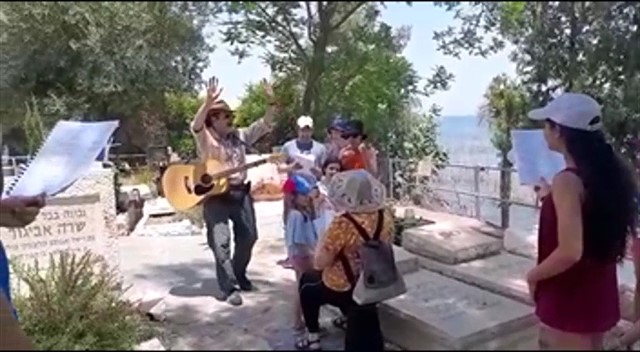
The tour was experiential: I played the guitar and the whole family sang using a songster that I prepared with a selection of songs of Rahel and Naomi. Aryeh was so happy to sing the songs which he loves so much, along with his whole family.
If you’re interested in a tour emphasizing songs related to different places in Israel, you’re invited to contact me at tours@joefreedman.co.il
To participate in an organized tour of Israel emphasizing folk dances and songs see: www.jimgold.com/folk-tours-2/israel-march-13-24-2023/
ביום שישי שעבר (24.6.22) היה לי את הכבוד ואת העונג להדריך את משפחת זריצקי המורחבת, בחגיגת יום-הולדתו ה-80 של המדען ד”ר אריה זריצקי (אוניברסיטת בן-גוריון).
המתנה שאריה קיבל הייתה סיור משפחתי בעקבות שתי יוצרות מהגדולות של השירה והזמר העברי: רחל “המשוררת” (בלובשטיין) ונעמי שמר.
טיילנו בחוות (או בחצר) כנרת הסמוכה למושבה כנרת, בחורשת האקליפטוס שע”י כביש הגישה לקבוצת כנרת ובבית הקברות כנרת: המקום שבו השתיים קבורות כה קרובות אחת לשנייה.
היינו עדים ל”שם הרי גולן…” ו”ראינו את הכנרת זוהרת בטורקיז”, דיברנו על העלייה השנייה והשלישית וכמובן על קורות חייהן של שתי היוצרות. הסיור היה חוויתי, ניגנתי בגיטרה וכל המשתתפים שרו בצמוד לשירון שערכתי של שירי רחל ונעמי.
אריה שמח כל כך לשיר את שירים האהובים עליו, לצד משפחתו במקומות המיוחדים הללו.
אם אתם מעוניינים בסיור בעקבות הזמר העברי במקומות שונים בארץ, מוזמנים ליצור קשר: tours@joefreedman.co.il

Categories
Two of the 73
On February 4, 2022, we mark 25 years since the “Helicopters Tragedy” (אָסוֹן הַמַּסוֹקִים), in which 73 IDF soldiers and aircrew were killed. It was a horrific accident involving two helicopters which collided as they made their way towards Lebanon, during what has been labeled the “First Lebanon War.”
The two helicopters, filled with commissioned officers as well as non-commissioned officers, flew at night in adverse weather conditions. They collided over moshav She’ar Yashuv, an agricultural community very close to the border with Lebanon, with one helicopter crashing straight into the moshav, and the other falling near kibbutz Dafna, a short distance away. It was the deadliest air disaster in Israel’s history.
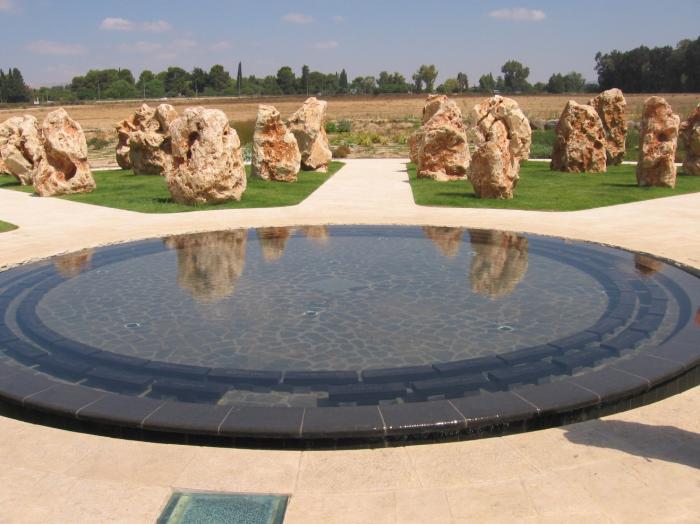
In 2008, a moving memorial was created on the property of moshav She’ar Yashuv, that the public can access without entering the moshav.
Late that night in 1997 I happened to have been watching the TV when the first reports of the tragedy were broadcasted. My thoughts immediately turned to our daughter Naomi, who was an adjutant officer in the Nahal – the unit in the army to which the majority of deceased had belonged. I was not fearful that Naomi was on one of the helicopters (she was non-combatant), but I knew that the tragedy would affect her tremendously. It turned out that she was immediately assigned to the family of St.-Sgt. Gilad Moshe Mishaiker, 20 years-old, from Jerusalem. She accompanied the family from just after their being informed of the worst news of all, through the funeral and burial at the Military Cemetery on Mt Herzl, continuing into the shiva (7 days of mourning) and beyond.
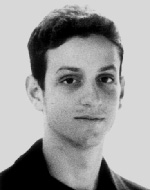
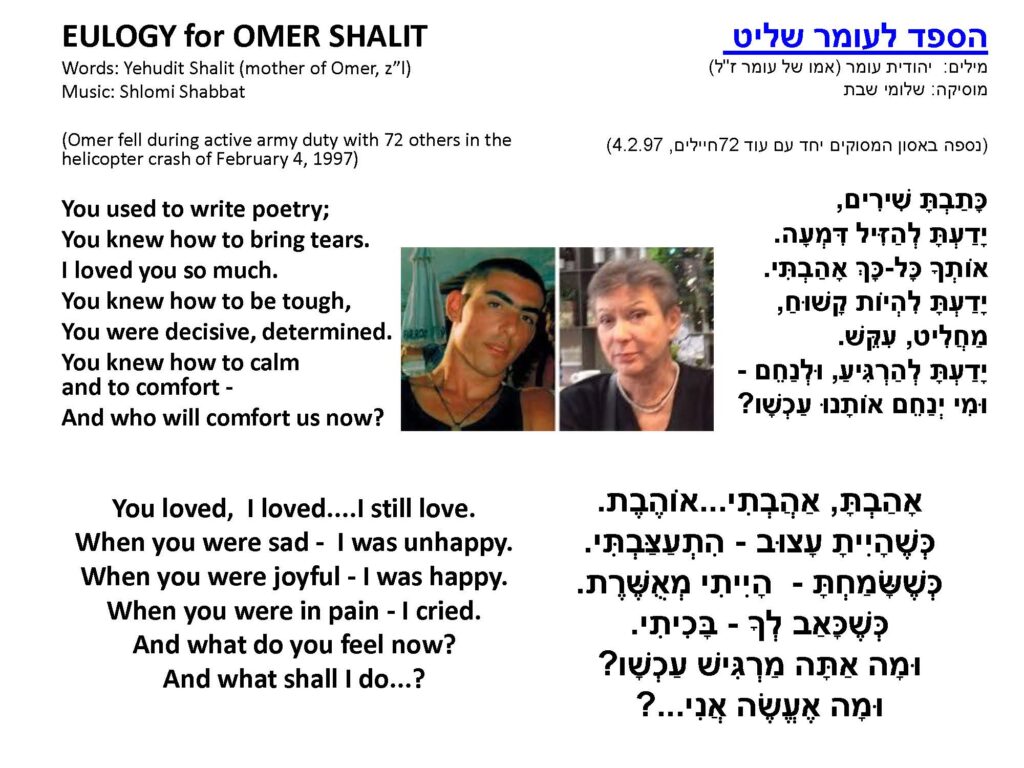
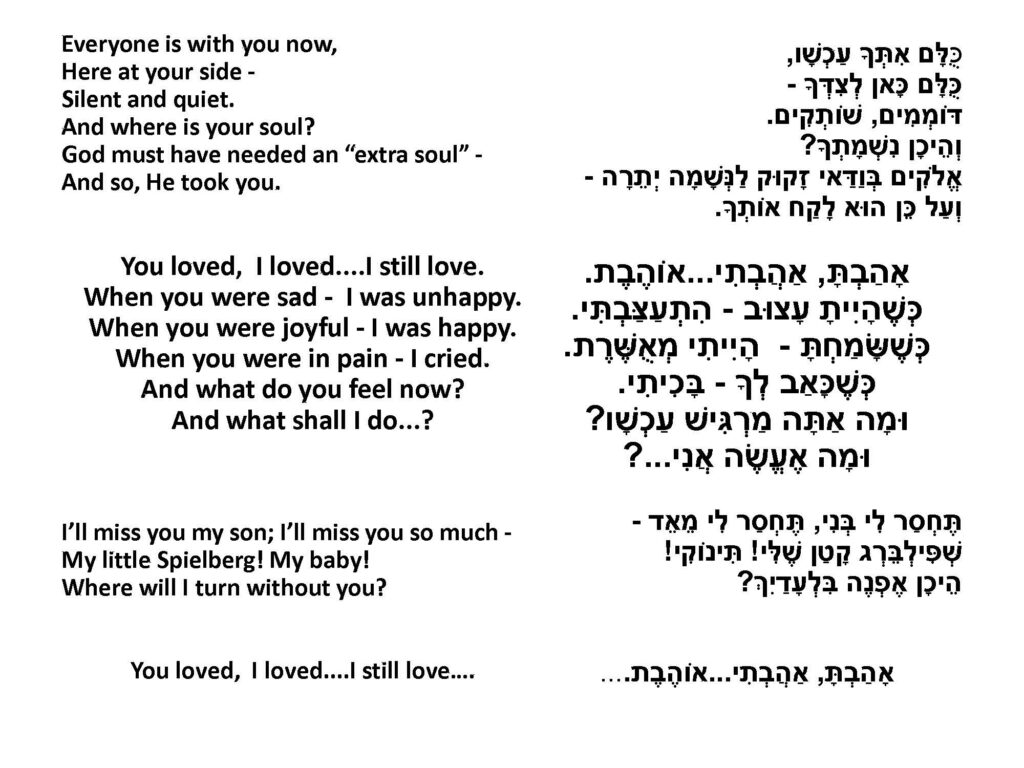
Another fallen NCO from Jerusalem – buried next to Gilad Mishaiker – was St.-Sgt. Omer Shalit, 19 years-old. Omer was a talented young adult, who wrote poems (as did his mother) and was especially interested in film. He was always running around with a video camera. The family used to quip: “Spielberg will yet work for Omer.” Following the devastating tragedy, his mother, Yehudit, wrote a poem: “A Eulogy for Omer Shalit.” The poem was brought to the attention of Shlomi Shabbat, a popular singer and songwriter. He wrote and recorded a hauntingly moving melody to the poem, which has been aired on the radio ever since, usually on Israel’s Memorial Day. It will probably be played on February 4th this year. I’ve listened to the song scores of times and I well-up with tears each time.
Accompanying this post are the Hebrew words to the poem as well as a translation, for which I take complete responsibility. Following is the link to Shlomi Shabbat’s song on YouTube (I hope that it will be playable overseas; please let me know ). https://youtu.be/RdvIapVK39o
May the memories of Omer and Gilad, and the other 71 people who perished in the Helicopters Crash be for a blessing.
Note: Photos of Omer Shalit and his mother Yehudit appear on the song lyrics.
Categories
Moses, Stage Fright…
…and a CONVERSATION with NECHAMA LEIBOWITZ
Fifty-nine years ago, for my Bar Mitzva, I chanted the Torah portion called “Va’era” (“And I appeared…,” Exodus 6:2-9:35) that we read this past Shabbat (1.1.22). It begins with a prelude to the 10 plagues. For the second time, Moses tries to convince God that he isn’t fit for the formidable task He is asking Moses to fulfill, as he is a “man of impeded speech” (Ex. 6:13). Previously Moses had pleaded, “Please, O Lord, I have never been a man of words, either in times past or now that You have spoken to Your servant; I am slow of speech and slow of tongue.” (Ex. 4:10).
Initially, Aaron served as the mouthpiece for his brother Moses; however, for the next 40+ years, as recorded in the Pentateuch, Moses talks ALL THE TIME! He speaks directly with God, with the Children of Israel, with his father-in-law, and so on. The book of Deuteronomy is almost completely a monologue spoken by Moses. What happened to the aforementioned speech defect?
There are some traditional responses to this question, but I tend to think that Moses was simply overwhelmed by the awesome responsibility of speaking to Pharaoh and doing whatever necessary to free his people. Perhaps he suffered from an emotionally-triggered impediment, or, in two words: STAGE FRIGHT.
I’m not a psychologist, but I have done enough guiding, teaching and singing, etc., to know that nervousness prior to performing can bring on psychosomatic reactions. Many veteran actors relate that even after decades of performing they still experience stage fright, which can sometimes be debilitating. However, in most cases, once they begin to speak (or act or sing…) the nervousness fades, or at least becomes less inhibiting.
Perhaps the same was true of Moses. While he and Aaron worked as a team, within a couple of chapters we “hear” Moses speaking directly to Pharaoh. At some point his impediment either disappeared, or was no longer paralyzing. In any case, he learned to deal with his disability.
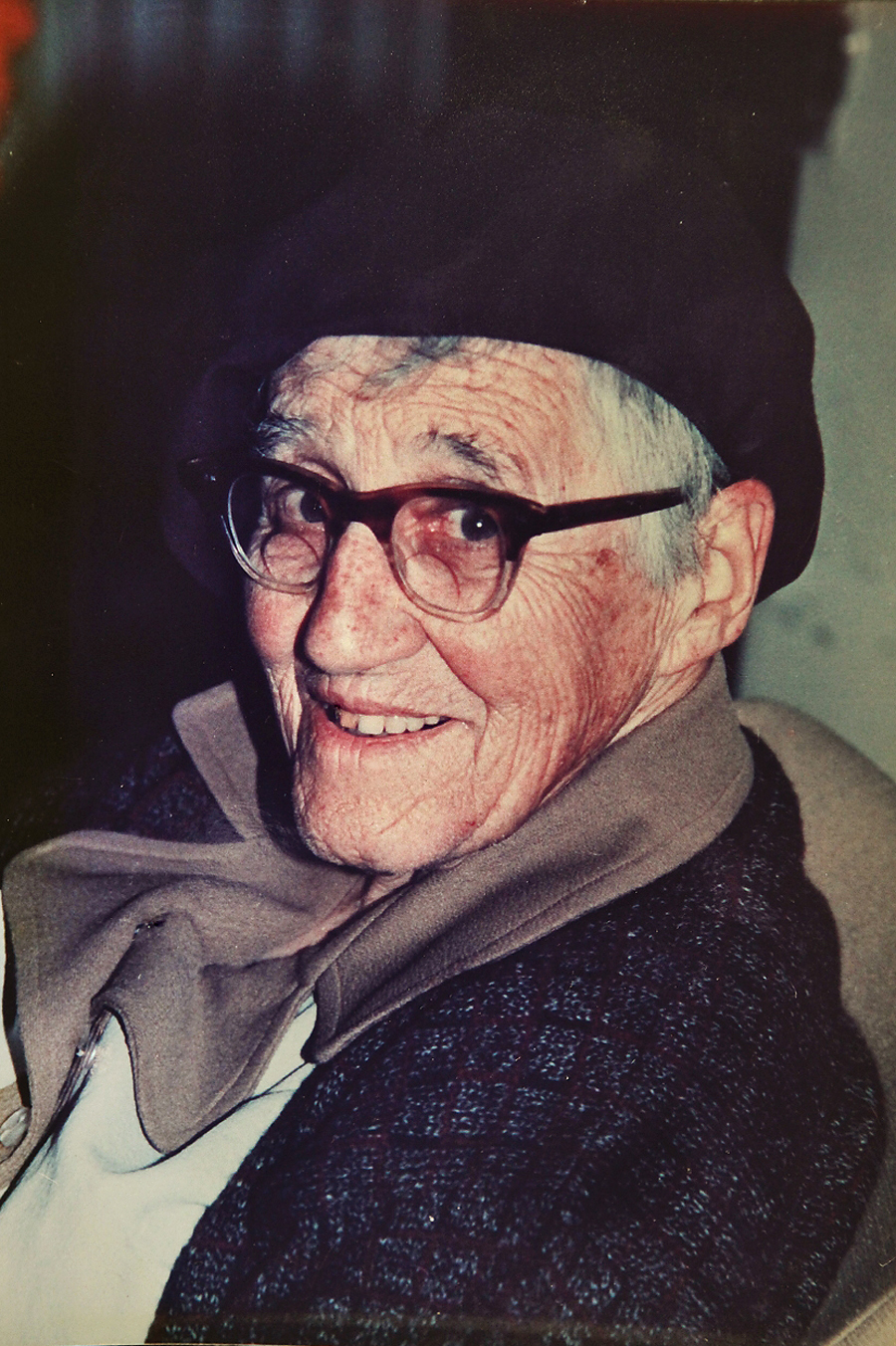
All of this brings to mind a phone conversation I had with the inimitable Prof. Nechama Leibowitz, ztz”l (may the memory of the righteous be for a blessing), who was both a leading expert in traditional Jewish commentators of the Tanakh /Hebrew Bible, and a master teacher of teachers. She taught thousands (perhaps tens-of-thousands) of teachers and carried on correspondence learning – through the snail-mail! – with hundreds of students of all ages. (See https://en.wikipedia.org/wiki/Nechama_Leibowitz)
Back in the mid-1980s, while working for the Hebrew University’s Melton Centre, I had the privilege of studying with Nechama (as everyone called her), at her tiny apartment in Jerusalem, every Tuesday evening, along with a group of senior teachers from abroad who were studying for the year at the Melton Centre.
One Tuesday morning I called Nechama to confirm with her about a lecture that she was to give the following summer. After clarifying what we needed to discuss, I asked her if I could come to her place a half-hour before the evening’s class to finalize plans for that lecture. This is how the conversation unfolded:
Nechama: I would be happy to meet with you, but only after the class, not before.
Joe: But, Nechama, after the class it’s late, you need to go to sleep (N.B. She was already over 80 at the time).
Nechama: No worries, I stay up late anyway. But before the class, I couldn’t possibly meet with you.
Joe (puzzled): Why not, if you don’t mind my asking?
Nechama: Because before the class I get nervous.
Joe: You get nervous?! You, Nechama?! How many years have you been teaching?
Nechama: I’ve been teaching for over 60 years and I get excited before every class. And OY VaVOY (woe be it) to any teacher who doesn’t get nervous before he or she walks into the classroom!
—–
Of all the wonderfully wise lessons I’ve learned from Nechama – whether from her books, her class or her many anecdotes that she would tell on the way – for me this was the greatest lesson of all.
I’ve told this story to many cohorts of tour guides and counselors that I’ve trained. I’ve emphasized that the pit-in-the-stomach, or cold-sweats, or just plain nervousness that we feel before public speaking, or meeting a new group, is natural and healthy. It keeps us alert and humble and reminds us that – like Moses – we are only human.
(Photo Credit: David S. Levin, from: https://jewishaction.com/cover-story/the-first-and-last-time-i-saw-nechama/)
Categories
Hebrew Language Day
HEBREW LANGUAGE DAY!!
YOM HaLASHON HaIVRIT – יום הלשון העברית
Time to Celebrate! In 2012 the Government of Israel formally declared the 21st of the month of Tevet as “Hebrew Language Day.” Since this year the 21st falls on Shabbat, the public observance of the day has been brought forward to Thursday, December 22, 2021.
Why the seemingly random date of the 21st of Tevet? And why do we need a day dedicated to the Hebrew language? After all, Hebrew is spoken throughout (most of) Israel on a daily basis and is studied as both a modern and a classical language throughout the world.
Due, primarily, to the efforts of one person, Hebrew was revived as a spoken language. That person was ELIEZER BEN-YEHUDA, who was born on the 21st of Tevet, 5618, corresponding then to January 7, 1858.
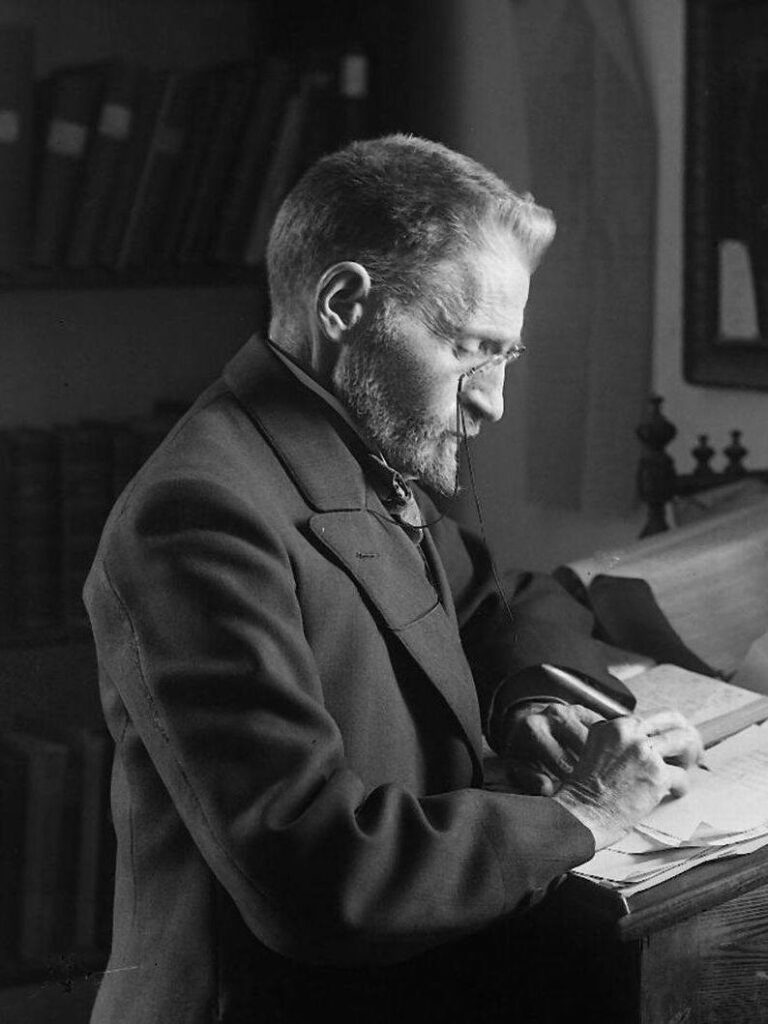
When Ben-Yehuda arrived in Palestine in 1881 he became convinced that the nation of Israel (the Jewish people) must speak its ancestral language: Hebrew. He ran into tremendous opposition from those that thought that Yiddish – among other suggestions– should be the common language. But he persisted, and spoke only in Hebrew with his son Itamar (originally named Ben-Zion; the latter changed his name after his mother died). Itamar became known as the first native-born Hebrew-speaker in 2000 years.
Imagine, if you will, taking an ancient language, like Latin or Acadian and turning it into a “living language” for debating in parliament, reporting the news, or building a multi-million dollar start-up. There were hundreds of vocabulary words that Ben-Yehuda had to come up with, basing himself on ancient Hebrew, Aramaic and even Arabic. Needing a word for electricity, he found the word חַשְׁמַל – “hashmal” in the first chapter of Ezekiel, which meant gleam or spark, and now we use that word for electricity, without thinking twice about it. Some of the words he invented didn’t quite catch on.
Other than writing an authoritative, multi-volume Hebrew dictionary (completed posthumously by his second wife, Hemda), his long-lasting accomplishment was establishing the Committee of the Hebrew Language (Va’ad HaLashon), which later became the Academy of the Hebrew Language. To this day, at its home on the campus of the Hebrew University in Jerusalem, the academy directs the development of Hebrew, including – but not limited – to inventing new words and terms.
The biography of AV”I (a Hebrew acronym for אֱלִיעֶזֶר בֵּן־יְהוּדָה – Eliezer ben Yehuda), and his family, is fascinating. There are many worthwhile websites and YouTube videos that you can find on your own.
AV”I died on the 26th of Kislev, 5683 – December 16, 1922. It’s interesting that in the Jewish tradition, we usually observe the anniversary of the death of a great leader, scholar, etc. How, appropriate it is that for the person responsible for the Rebirth of the Hebrew language, we mark his birth! May his memory be for a blessing!
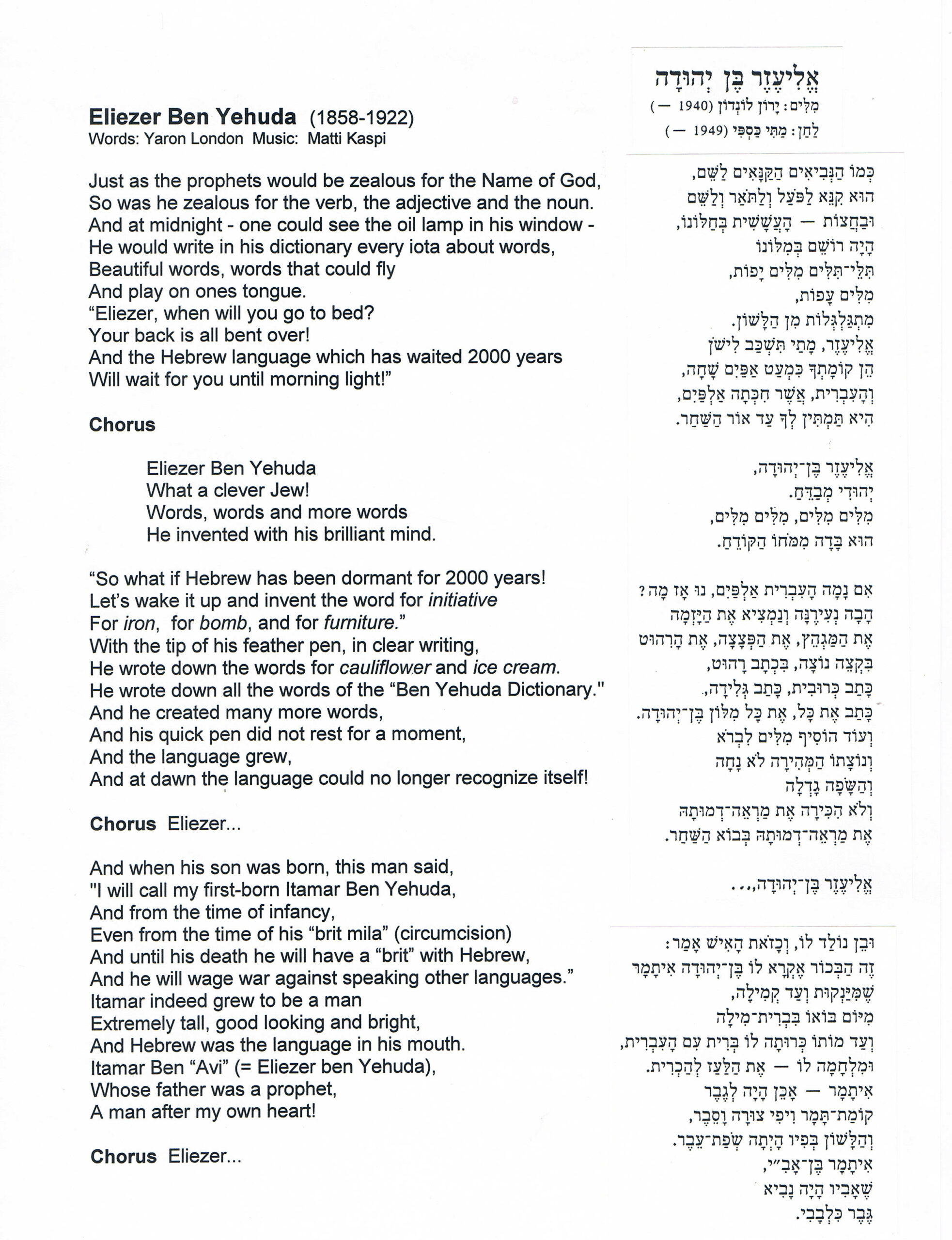
When you come to Israel I’ll be happy to take you to two buildings which served as AV”I’s homes in Jerusalem. In the meantime, enjoy the charming song about AV”I on YouTube. The link below is for the Hebrew text and English translation.
https://www.youtube.com/watch?v=HYGeOEziQtY&list=PLKblw3yQy_qjHzpHisxokmKRQH3lv0sHU
Categories
The First Cliffhanger
Saturday night, December 4, 2021
In the Jewish Tradition we read a portion of the Torah every week on Shabbat (Saturday) morning, completing the Five Books of Moses each year. The weekly portions were established prior to the division of the Hebrew Bible into chapters (which was developed by Christian clergy in the 13th century). There are several times when the end of one Torah portion gives us a preview of what’s to come, but this week’s portion is definitely a “page turner” – or perhaps a scroll-roller!
This morning, in the Genesis portion called Miketz (“AT THE END of two years…”), we read the continuation of the Joseph Cycle, which began last week. Miketz starts with Chapter 41 (Pharaoh’s dreams) and ends with Ch. 44, verse 17, when Joseph says to his brothers: “Only he in whose possession the goblet was found (i.e. Benjamin) shall be my slave; the rest of you go back in peace to your father.” Stay tuned for next week’s drama!
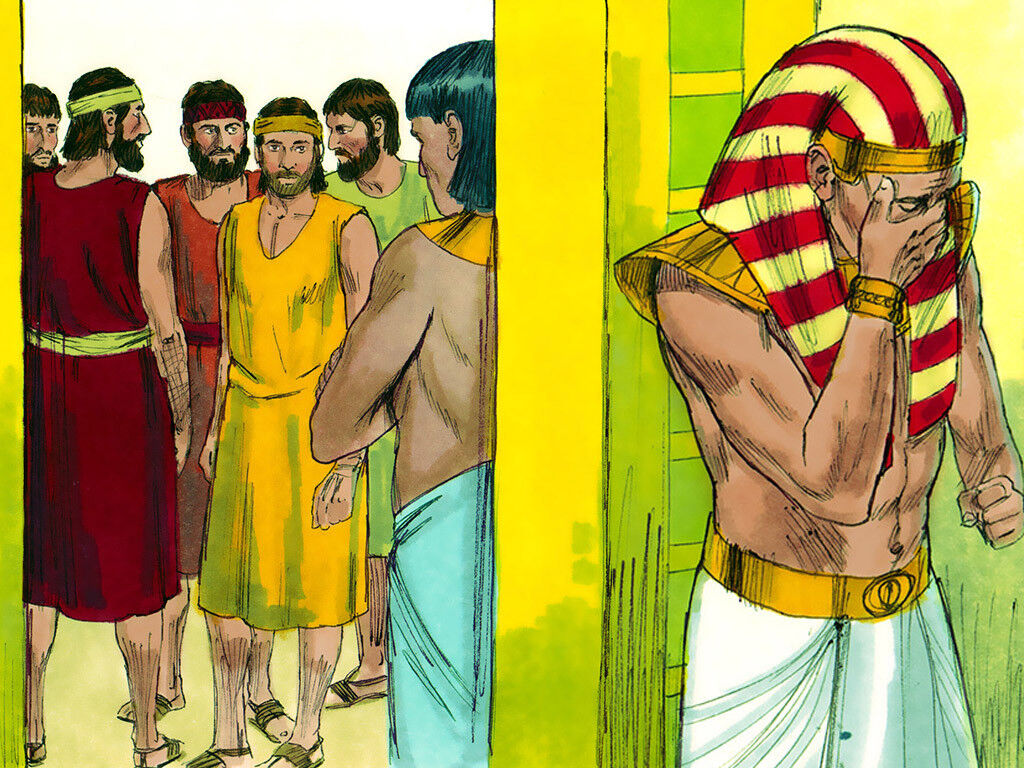
Even though for over 60 years I’ve known how the story unfolds, every year my eyes well-up with tears hearing-and-reading the several times when the mighty viceroy of Egypt, Joseph, breaks down and cries several times in private – at least up until this point.
And then the portion leaves us with a cliffhanger! What’s going to happen to poor Benjamin?! What’s Judah going to say to his father Jacob (AKA Israel)?
So this morning – as if I didn’t know how the story develops – I found myself having my annual sneak preview, reading ahead in next week’s portion, Vayigash, to the end of Ch. 41 and into Ch. 45 – at least through verse 16. Here Joseph breaks down and cries in the presence of his bothers, who were dumbfounded by Joseph’s revelation. Then Joseph cries on Benjamin’s shoulder (literally: the back of his neck) and those of the rest of his brothers. Get out the tissues!
Why does the story affect me so much? Maybe it’s because of my namesake (though “Yosef” is not my given Hebrew name; long story), or the fact that, like the protagonist, I’m the penultimate child in a large family (in my case there were 6 children, Joseph had 11 brothers and a sister). Maybe it’s because I cry at weddings and movies – sometimes because the latter are so bad! Or perhaps it’s because this is some of the best literature ever written.
Want to spend a fascinating few minutes? Take a look at the text and trace the circumstances in which Joseph cries. What does it say about Joseph? What does it say about leadership? What does it say about us?
Many wishes are in order: Shavua tov (have a good week), Hodesh Tov (have a good month of Tevet), and Happy Hanukkah (Happy Hanukkah!). Other season’s greetings to follow.
———-