Categories
Media

The Other “Home Front”

וַיֹּ֨אמֶר אַבְרָ֜ם אֶל־ל֗וֹט אַל־נָ֨א תְהִ֤י מְרִיבָה֙ בֵּינִ֣י וּבֵינֶ֔יךָ …כִּֽי־אֲנָשִׁ֥ים אַחִ֖ים אֲנָֽחְנוּ׃

…فقال ابرام للوط لا تكن مخاصمة بيني وبينك …. لاننا نحن اخوان

‘Abram said to Lot, “Let there be no strife between you and me…
for we are kinsmen…’
(Genesis 13:8)

While most of the news media and social media have focused on the conflict between Hamas in Gaza and Israel; unfortunately, that’s not the only front on which Israel is fighting.

The recent intra-city rioting between Arabs and Jews in “mixed cities” (where there are significant populations of both subgroups) has been extremely worrisome. There are those who have said that it is as dangerous and ominous as the rockets being shot from Gaza. While some of these cities (such as Lod and the Jaffa section of Tel Aviv) have seen sporadic confrontations between Jews and Arabs, in recent months and weeks, there has been major rioting – on and off – since Sunday, May 9th.

Sadly, there has been a lot of rock-throwing, destruction and even a few deaths. At least ten synagogues have been torched (though no mosques) and nearly 700 Jewish homes have been burned or damaged (much fewer Arab homes). While, by far, most of the rioting has been carried out by Arabs (the majority of whom are aged in their teens and 20’s), there have also been radical Jewish groups who have retaliated and vandalized Arab neighborhoods.

There has been a lot of criticism directed at the Israeli Police who have not been proactive (to say the least) in curbing the violence or in trying to prevent it. In the last few days the General Security Service (“Shin Bet”) has been brought in to try to augment the work of the police and Border Police.

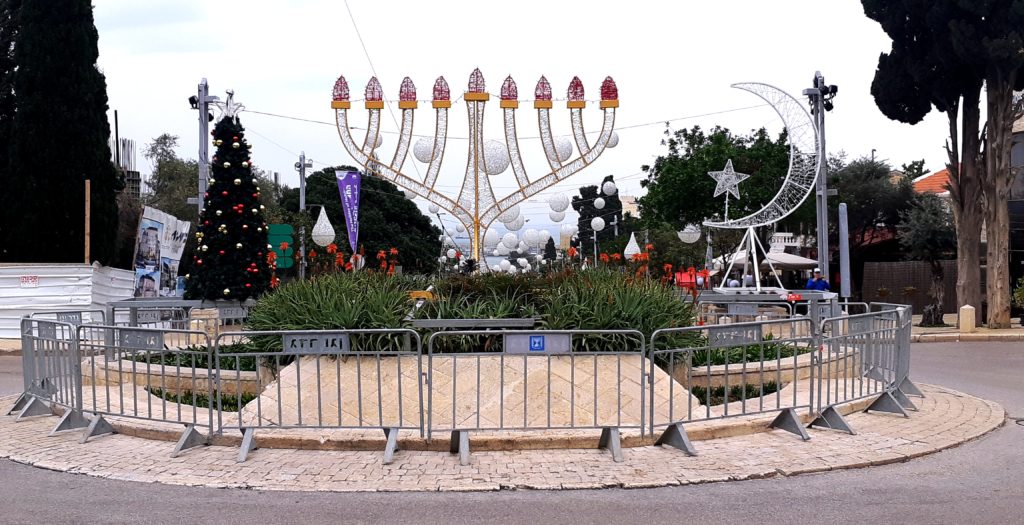
This round of rioting has been particularly disturbing since cities like Haifa and Acco (Acre) have been bastions of coexistence between Jews and Arabs – both Muslim and Christian – for decades (see the picture below of Haifa with the symbols of the three religions). As a tour guide I have often walked tourists through Arab sections of Acco, Haifa and even Jaffa – without a worry about our safety. It saddens me to see the peaceful coexistence begin to unravel.

A Jewish colleague who lives in the Galilee wrote that he often goes into Arab towns and villages for services (shopping, medical care, etc.). He’s not so sure that he will be able to do so safely in the foreseeable future. On the TV last week we witnessed Jews in one of the aforementioned cities being escorted by the police from their homes to safety. This was a sight that no one dreamed of seeing in the Jewish State.

Nevertheless, there have been some positive developments: There have been some Arab Knesset (parliament) members, as well as local leaders, who have publicly implored the Arab rioters to desist. There have been peaceful demonstrations of Arabs and Jews who have pleaded for the violence to cease and to renew the productive coexistence and civil cooperation which prevailed up to just 9 days ago.

On the television there have been public service announcements showing Arab/Jewish work partners standing shoulder to shoulder (from factories to hospitals….), as well as local friends – Jews and Arabs – from the aforementioned cities who were sitting in each other’s yards speaking about how their lives are intertwined where they live. And, as I write (May 18th in the evening), there are reports that in Lod – which has been particularly violent – the rioting has abated significantly and there are public gatherings of Arabs and Jews happening right now in which the two groups are trying to renew their shared destinies.

Where will all this lead? No one knows for sure. There are some analysts who claim that we are seeing the beginning of a civil war, or at least a third Intifada (Arab uprising); others believe that once there is a ceasefire between Hamas and the Israel Defense Forces that the civil unrest will begin to ebb. As one who believes strongly in coexistence, I pray that all Israeli citizens will come to their senses and will rebuild our common lives. May it be God’s will. בעזרת ה’ , إنشاء الله.

(I took the following photo of the roundabout at the bottom of the Bahai Gardens in Haifa, during the “Holiday of Holidays Festival” פסטיבל חג החגים – مهرجان عيد الأعياد which the city celebrates every December, involving all three Abrahamic religions)
Categories
Media Torah Portion

Proverbs and Israeli PR

In studying the book of Proverbs (Ch. 26 – today’s chapter of the daily Tanakh/Bible study program called “929” – the number of chapters in the Hebrew Bible), I came across two consecutive, contradictory verses (vs. 4-5) that are most apt for responding – or not responding – to anti-Israel and anti-Zionist media:

אַל־תַּ֣עַן כְּ֭סִיל כְּאִוַּלְתּ֑וֹ פֶּֽן־תִּשְׁוֶה־לּ֥וֹ גַם־אָֽתָּה׃

Vs. 4: Do not answer a dullard in accord with his folly, Else you will become like him (literally: become his equal)

.עֲנֵ֣ה כְ֭סִיל כְּאִוַּלְתּ֑וֹ פֶּן־יִהְיֶ֖ה חָכָ֣ם בְּעֵינָֽיו׃

Vs. 5: Answer a dullard in accord with his folly, Else he will think himself wise.

So which is it? Do we try to respond to misguided, skewed anti-Israel propaganda in kind? Do we “lower ourselves” to the dullard’s level? Or do we ignore it, knowing that many of the anti-Israel bloggers, and the like, are not interested or capable of hearing what we have to say? (To paraphrase a Hebrew expression: if they say your sister is immoral, try to prove that you don’t even have a sister!)

Of course, the Talmudic answer is: “It depends….” We certainly don’t want to counter anti-Israel tirades with more tirades – that would be like the first verse above and would lend credence to their baseless claims. On the other hand, when encountering well thought-out criticism (even if it makes us uncomfortable), perhaps the second verse would indicate that we should try to respond rationally. Such criticism will usually be based on facts – or include kernels of truth – which we ought to recognize. If we fail to do so it will undermine the legitimacy of our position. At the same time, we need to point out where the critic is mistaken. We might not convince the critic of the correctness of our argument, but at least we can demonstrate that the critic is not as wise as s/he may think s/he is (vs. 4 above).

In my humble opinion, the most effective “response” to the dullards out there is to take the rhetorical offensive: send out LOTS of PR explaining what Israel is doing and why BEFORE Israel is forced to be on the journalistic defensive. Flood the social media with information (being cautious not to sound self-righteous – yes, Israel does make mistakes, but…). I realize that the anti-Zionist sentiment will always be there, but at least we will not “become like him” (as per vs. 4). Israel is a world leader in developing hi-tech; however, when using that technology for PR, the State of Israel is still in the dark ages.

Let’s do our part in trying to make up for some of the Israeli government’s PR sluggishness. Keep sharing those posts that resonate with you and that you think contribute to support Israel. Take part in webinars or other forums to be better educated and to spread the word to others. At this writing (Tuesday AM, May 18) it looks like the current fighting could be over by the end of the week; unfortunately, the PR War will be with us for a long time to come.

https://www.929.org.il/lang/en/today

Categories
Literature Personalities

Occupy Oneself with Jerusalem

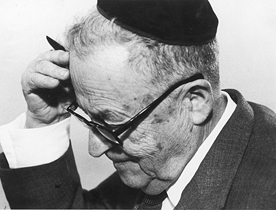
In honor of Jerusalem Day, following is one of my favorite quotations of S.Y. Agnon, who was awarded the Nobel Prize for Literature in 1966, from the collection of his short stories “Within the Walls”, (the Hebrew follows the English translation; I take responsibility for the latter):

There are places in Jerusalem that are familiar to me, and that I know well. But when I chance upon one of them, it seems to me that I’ve never seen it before.

In contrast, there are places that I’ve never been to before in my life, but when I chance upon them it seems to be that they are familiar to me, and I know them well.

And since all the days – including the nights – I would wander through the [streets and] squares of Jerusalem, I didn’t make the time to learn any trade. Even worse, I didn’t make time to study Torah. And a Jew who doesn’t occupy himself with Torah – his heart berates him and says, “And what will you answer on Judgment Day when they ask you if you occupied yourself with Torah?” What would I answer? I would answer: “I occupied myself with Jerusalem,” and I’m confident they will say, “You did well!…”

מקומות יש בירושלים שאני מכיר אותם ויודע אותם וכשאני מזדמן לאחד מהם דומה עלי שלא ראיתיו מעולם.

כנגדם יש מקומות שמימי לא הייתי שם וכשאני בא לשם דומה עלי שאני מכיר אותם ויודעם.

ומחמת שכל הימים לרבות הלילות מרבה הייתי לשוטט בחוצות ירושלים לא פניתי ללמוד שום אומנות. קשה מזה הייתי בטל מן התורה ויהודי שאינו עוסק בתורה ליבו מוכיחו ואומר, ומה אתה משיב ביום הדין כשישאלו אותך עסקת בתורה. ומה הייתי משיב. הריני משיב עסקתי בירושלים, ומובטחני שיאמרו לי יפה עשית…

מתוך ש”י עגנון: “לפנים מן החומה”

!חג שמח

Categories
Holidays Jerusalem Music Personalities

Light and Jerusalem / אור וירושלים

Starting Sunday evening, May 9 through Monday, May 10 we observe “Yom Yerushalayim” – Jerusalem Day, marking the day on the Hebrew calendar when the Old City of Jerusalem (and especially the Kotel  – the Western Wall), was liberated during the Six-day War and became part of one united Jerusalem under Israeli control. For many in Israel – and throughout the Jewish world – this is both a national and religious holiday. (Not everyone sees it that way.)

For me, the holiday is particularly significant, as I was blessed to visit Israel and Jerusalem for the first time, on the Ramah Seminar, during the summer of 1967 – just a few weeks following the Six-Day War. Thirteen years later my family and I moved to Jerusalem. For nearly 40 years our home has been in the southern neighborhood of Gilo, founded just four years after the war in what became Greater Jerusalem.

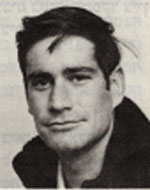
Yosef Sarig, 1944-1973

There have been many songs written about Jerusalem – before and since the Six-Day War. I would like to share one of my favorites with you – less known internationally than the famous “Jerusalem of Gold.” The song, “OHR VIRUSHALAYIM” – “Light and Jerusalem,” was written by Yosef Sarig (pronounced: sah-REEG). On this post you’ll find a link to one of several renditions of the song, as well as a link to the lyrics in Hebrew and English. The story of how it came about is as moving as the song itself:

The following is based on recollections by Yosef’s mother and brother, Tikva and Tzachki.  His father was General Nahum Sarig, commander of the legendary Palmach unit in the Negev Desert during the 1948 War of Independence.

The Sarig family lived on kibbutz Bet Hashita in the Bet She’an valley in the north of Israel. In January of 1963, Yosef’s grandmother died. Since she was a fourth – or fifth – generation Jerusalemite, the parents borrowed one of the kibbutz trucks to bring the deceased to eternal rest in Jerusalem. The parents sat in the cabin of the truck and their five children sat in the back – together with the coffin. It was a particularly wintry day and it poured most of the way. All of a sudden, as they approached the beginning of the steep ascent to Jerusalem (at Sha’ar Hagai), the sun started to come out and a rainbow appeared. The rays of the sun piercing through the clouds, which accompanied them all the way to the cemetery, particularly made an impression on Yosef.

In January, 1972, Yosef, who was a talented musician and song-writer, was asked to write a song about Jerusalem for the Gevatron (singing) Ensemble’s performance in honor of Jerusalem Day that year.  One evening he went to his room and in matter of hours wrote both the music and lyrics for the song. He came out and – as was his custom – he showed the lyrics to his mother asking if it was any good. She saw right away that his words described the light that they had seen on their way to Jerusalem exactly nine years earlier. She looked at him and said, “It’s enchanting… but what about the music?” He pulled out another page with the music which seemed to resonate perfectly with the lyrics.

On October 10, 1973, just a year and five months after the song was first performed, Major Yosef Sarig fell in battle on the Golan Heights. He was buried in his kibbutz along with ten other sons of the kibbutz who died in the Yom Kippur War. (The kibbutz was the community in Israel with the highest per capita casualties of that war.) Yosef’s brother, Tzachki, had been wounded at the beginning of the war and was in the hospital when Yosef was killed. His family waited until Tzachki was on his way to recovery before telling him the sad news. He became depressed with guilt, saying: “Why him and not me!”   


OHR VIRUSHALAYIM  became an instant “hit” and ever since has become an integral part of Israel’s musical legacy. It’s been translated into several languages. A folk dance to the song was choreographed by Shoshana Koplewitz. Ironically the lyrics do not mention the name of the city, except in its title. There’s no need; the song describes Jerusalem in a most unique and beautiful way.  In 1975 Yosef was posthumously awarded the Medal of Distinguished Service (Itur Hamofet), but his songs – especially Ohr Virushalayim – were his awards to the nation. May his memory continue to be for a blessing.

Some links:

The song as sung by the Gevatron Ensemble:

https://youtu.be/94M7zG-Hcy4


The lyrics in Hebrew and English: See PDF above to view or download.

A clip of the folk dance (for instructions for dancing, watch from the beginning of the video).
https://youtu.be/KQAVpGdj4z4?t=152

שַׁ֭אֲלוּ שְׁל֣וֹם יְרוּשָׁלִָ֑ם יִ֝שְׁלָ֗יוּ אֹהֲבָֽיִךְ׃
Pray for the Peace of Jerusalem.
May those who love you be at peace. (Psalm 122)