The amazing festival of lights in Jerusalem! Even if you can’t make it to drive around the city to the displays you can enjoy it vicariously by clicking above. You’ll find some very brief guiding clips for the different sites (yours truly “appears” at the Israel Museum and at the Cinematheque bridge). Enjoy and have a most festive Purim!

(a composite from the Hebrew press, February 18, 2021)
Maher Ibrahim (see picture below) is a Muslim who lives in the bedouin village of Daburiyya at the foot of Mt. Tabor. He works as the head nurse in the Covid-19 ward in Ha’Emek Hospital in Afula in the north of Israel. Recently he found himself in a most unusual situation that led to him to take a Siddur (Jewish prayer book) and read the “Sh’ma Yisrael…:” (“Hear, O Israel, the Lord our God, the Lord is One,” Deuteronomy 6:4) for a patient – a Chabad chassid, Shlomo Galster, 74 years old.
In the words of Nurse Ibrahim:”There was a religious, Jewish patient whose condition was deteriorating quickly towards death. We contacted the family and they set out on a journey from the area of Netanya to Afula, and were delayed by weather and traffic. All their way we prayed that the family would make it in time – at least to see their father in his final moments. Unfortunately, his death was imminent and would occur before the family would arrive.”
He related on a radio program this morning that his professional experience had taught him that many people, regardless of religious affiliation, ascribe tremendous importance to the final prayer before death:
“I studied for an MA in gerontology at Ben Gurion University (Beer Sheba), and I took a couple of courses in Judaism. One learns how to connect Judaism to the world, to life and death. I’m not familiar with all the (Jewish) prayers, but I know that it is customary to say “Sh’ma Yisrael” before the end of life, so I stood at the head of the bed and said, “Sh’ma Yisrael”. By the time his daughter arrived, it was too late – he had already expired. I could see that she was looking for closure, so I told her what I had done.”
He added: “I told the daughter that I didn’t know if what I did was acceptable or not because I’m Muslim and he’s Jewish. But I said it (the Sh’ma) and if he heard me, then the prayer was the last words he heard…” According to Maher, towards the end of Shiva the daughter called him and said that his actions were the only thing that gave her comfort, and that she looked forward to the end of Corona to give him a hug.
Maher: “The reaction of the daughter warmed my heart. Sometimes we’re the last voice that a patient hears, especially during COVID-19 with the closed wards and inability to arrange meetings with the families. We (the staff) need to be human beings for the patients before we are there for them as medical professionals. This is what needs to be done and we will continue to do.”
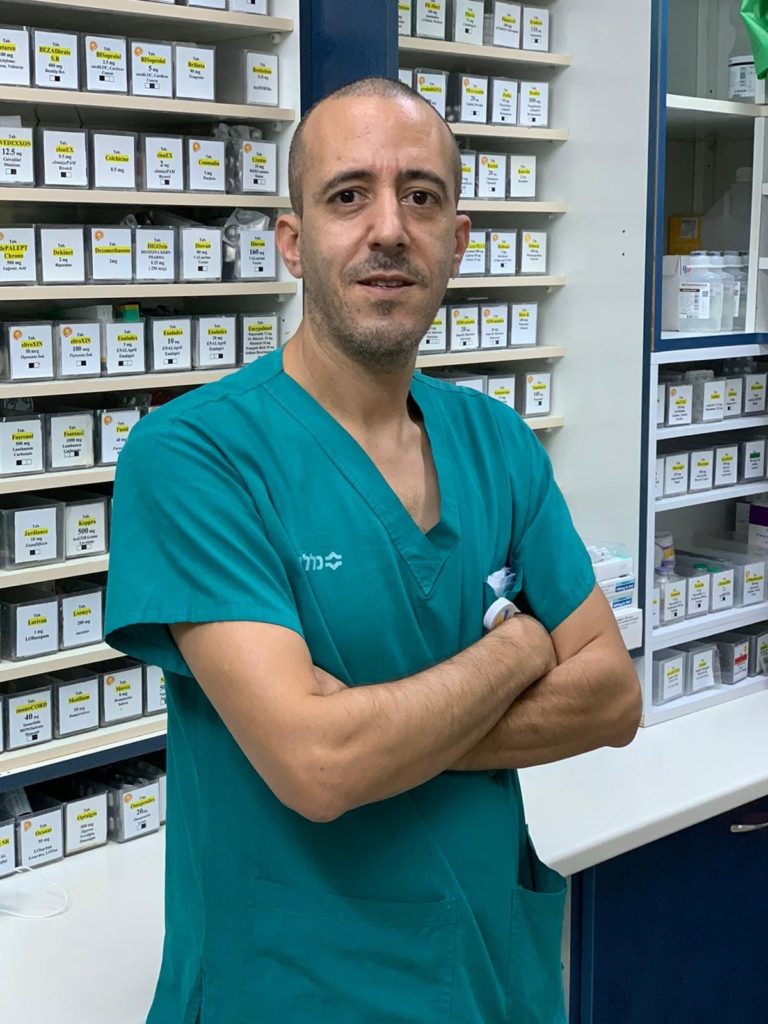
(Photo from Facebook of Yoseph Haddad)
In 2005, in a residential neighborhood of Jerusalem, archaeologists discovered a huge water cistern (reservoir) from the Byzantine Period, some 1500 years ago. Watch this brief video to see how this came about:
Joe Freedman, Ed.D.
(In honor of International Holocaust Memorial Day, January 27)
“A good name is better than fragrant oil” (Ecclesiastes 7:1)
Did you know that Jerusalem has a street named: רחוב צביה ויצחק
“Rehov Tziviya ve-Yitzhak” (Zivia and Yitzhak street)? Jerusalem – as well as most cities in Israel – is super meticulous about naming streets. There are two very prestigious committees which makes decisions about the City’s street names, one headed by a former Supreme Court judge!
One can learn a lot by just walking down the streets of Jerusalem and paying attention to their names. Sometimes a street-sign gives a few word explanation of its name. Many street names memorialize personalities from Jewish and Zionist history (from Ruth to King David to King Agrippa to Theodor Herzl…). Some neighborhoods have street names with a common theme or period of history (the 12 Tribes, medieval Jewish scholars and poets…). In my neighborhood of Gilo (first established in 1971), walking through the streets you’ll mostly “meet” streets named for flowers, precious stones and spices (I live on Ha-Rosmarin – Rosemary – st.).
Among the few streets named for people in our neighborhood is “Zivia and Yitzhak Street.” Since moving to Gilo in 1982, I’ve always found that name to be strange. It’s rare that one street is named for two people (and using just first names at that), but I never bothered to do any research about it.
That changed just a few weeks ago: as I took a brisk walk down that street (which is actually the continuation of my own), I ran across a large mural, put up along where the new light railroad line is being built (see picture below). I did a double-take as I noticed that the mural showed a picture of:
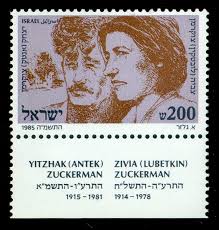
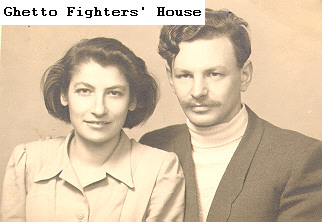
ZIVIA and YITZHAK:
Zivia (Lubetkin) Zuckerman (1914-1978) and
Yitzhak Zuckerman (1915-1981)!
It turns out that they were true heroes of the Jewish People. In fact, the mural capsulizes the story of the couple in five short points. Following is a free translation (and explanation) of those points:
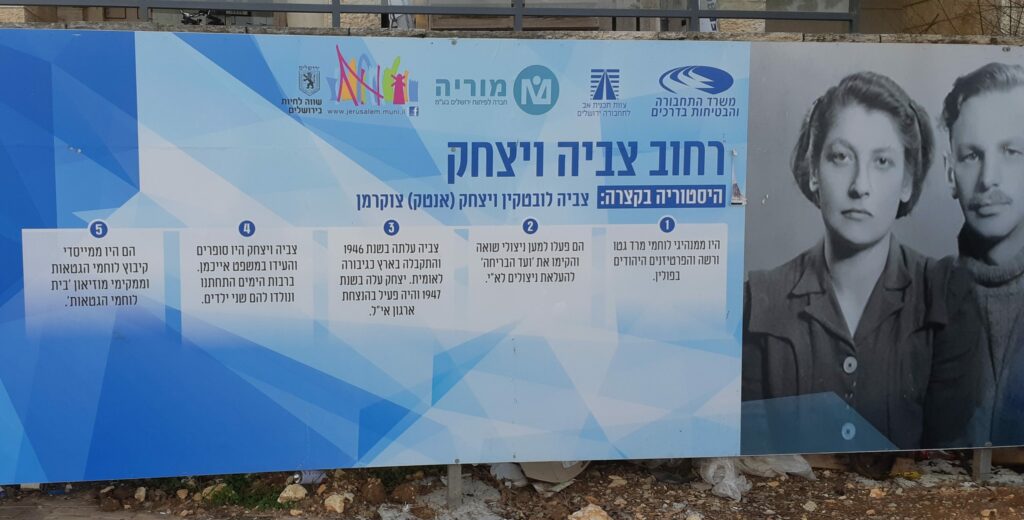
1. Zivia (nee Lubetkin) and Yitzhak (wartime codename: “Antek”) Zuckerman were among the leaders of the Jewish Partisans in Poland as well as of the Warsaw Ghetto Uprising (April-May, 1943 – they were two of the mere 34 survivors of that Uprising).
2. After World War II they looked after fellow Holocaust survivors and took part in establishing the “Bericha” (escape) network to smuggle survivors out of Europe and into Eretz Yisrael (the Land of Israel).
3. Zivia made Aliya (moved to Eretz Yisrael) in 1946, and was received as a national heroine. Yitzhak made Aliya in 1947 and was active in the memorializing of leaders of the ZOB (the Jewish Combat Organization in Poland during World War II).
4. Zivia and Yitzhak were writers. They testified at the trial of Adolf Eichmann (1961). They got married and had two children: Shimon and Yael.
5. They were among the founders of the Ghetto Fighters Kibbutz (Kibbutz Lohamei HaGheta’ot) as well as the Holocaust museum (Bet Lohamei HaGheta’ot) on the premises of the kibbutz.
Do you see what you can learn by just walking down the street?! For more details about these remarkable heroes, do some Googling! I just wanted to add to the five points that in 2001, their granddaughter, Roni Zuckerman, became the first female jet fighter pilot in the history of the Israeli Air Force.
May the memory of Zivia and Yitzhak be for a blessing. – יהי זכרם ברוך
Shalom to all! Here in Israel life is slowly returning to “normal,” though we still have a long way to go. Since international travel is still weeks or months away, I decided to bring some clips of Israel to you: IsraCLIPS. Of course nothing can replace being here and being part of the landscape, but in the meantime I present a series of short video clips behind-the-scenes sites in Jerusalem and other places in Israel (and perhaps some well-traveled sites as well).
Our first installment is about an amazing discovery in burial caves from the First Temple Period (6th Century BCE). I’m happy to get your reactions and questions. By all means please share!
In honor of Israel’s 72nd birthday (which was celebrated on April 29), some tour guide colleagues – and yours truly – put together a short video of Israel sites. We hope you’ll get to Israel soon to see them in real time! The background song, written and performed by Hazzan Iris Beth Weiner says, “I’m so grateful for the State of Israel!”
In celebration of YOM HA’ATZMAUT – Israeli Independence Day (which was celebrated on April 29) – I’m honored that the World Mizrachi Movement (religious Zionists) has asked me to “guide” a virtual tour called:
“THE CITY LINES OF JERUSALEM:
1948-67 and 1967 – TODAY.”
The virtual tour can be found below. Following is a quick description:
Through rare photos and maps we trace how the borders of Jerusalem were determined in 1948 and then changed radically in the aftermath of the Six Day War in 1967. We look at how city and its borders developed in subsequent years and how the Security Barrier has impacted on the character of the city. (42 minutes).